
The stout Nebraskan man from Seneca functioned more or less as a sherpa, not a guide. I say this because although the stout Nebraskan man was from Nebraska, and not Tibet, it would be more accurate to refer to him as a sherpa because there is no other way to describe the Anthill as mountainous. In that same vein, one could argue that the Nebraskan could just as easily be described as a spelunker, because the Anthill is in every aspect just as cavernous as it is mountainous. And for that matter, he could also be considered a pioneer, because the Anthill is just as horizontally vast as it is cavernous and mountainous, unending in all ways equally.
The Nebraskan man could be all three of these things at once and they’d all be perfectly accurate descriptors of what exactly he does, but instead, the Nebraskan liked to refer to himself as an astronaut because he was, “pretty damn good at exploring spaces.” And after he’d told me this, jamming roughly his elbow into mine, I was sure that in another life he could’ve been a comedian.
The eve of our expedition into the Anthill was spent largely in this way; drinking, chatting, acclimating ourselves to one another whilst socially lubricated so that we wouldn’t have to do any of that while venturing into the Anthill. I make it out to sound like conversation with the Nebraskan was a chore—and in many ways it was purely because it was mandatory—but he was a very pleasant man to talk to. Interesting. Fascinating. Jovial. For a man who’d never left his home state, only ever once traveling to the Nebraskan border “just to get a whiff of the air they got in Wyoming,” he had the eyes, cadence, and stories of a well-travelled individual. And in some ways, you could argue that he was—that he was more well-travelled than even history’s greatest explorers. Leif Erikson, Lewis and Clark, Amelia Earhart, Neil Armstrong, James Cameron1, Christopher Columbus2, Francis Drake, Hernán Cortés, etc.—none of them compared to the Nebraskan man because while the Nebraskan man hadn’t discovered America, or set foot on the moon, or
1 Debatably.
2 Controversially.
been to the bottom of the Mariana Trench, or circumnavigated the globe, the simple fact of the matter is he had set foot inside the Anthill, and they had not. That alone put him in a league entirely of its own. And I admit, there was a sort of giddiness, too, that came with knowing I would soon be joining the Nebraskan man in that regard.
He had been there in the Anthill’s earliest days, had the privilege of exploring it thoroughly in the months before its existence had become common knowledge, before the people started flocking to it, before the government had got involved and the fences had gone up and the patrols had started and access to the Anthill had been heavily, heavily restricted. The Nebraskan man had the privilege of this unrestricted exploration simply because the Anthill happened to be discovered, completely by accident, on his property.
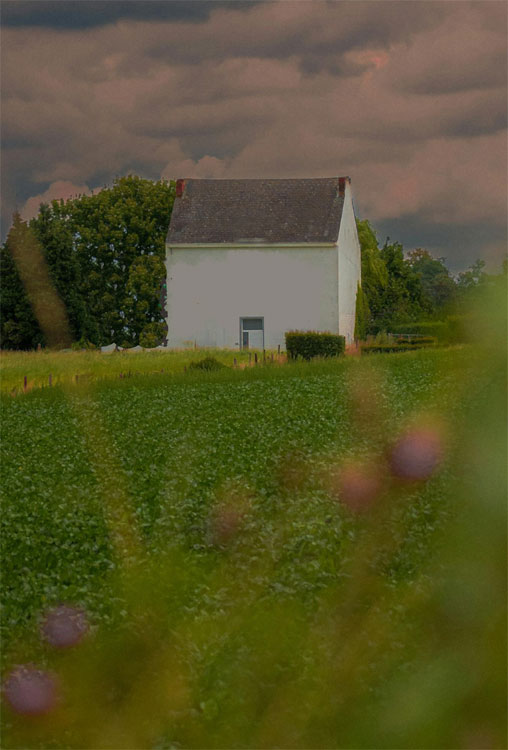
It was a teenager who’d found it, not the Nebraskan man, and she likely wouldn’t have found it at all had she known where she was going that day. The school bus driver had mistakenly dropped her off one street down from where she was supposed to be delivered, and so, feeling particularly adventurous for no particular reason other than it being a crisp fall day, the girl cut through the woods, traveling as the crow flies instead of along the road to get home. This unorthodox path would lead her, eventually, coincidentally, some would say unfortunately, to stumble upon the white-painted house with six rooms, no windows, and one door that would come to be known as many things, but mainly as the Tumulus:3 the entrance to the Anthill.
God, to be there—a fly on the wall staring back in multitudes at the teenager as she stood still in the center of the clearing, back to the orange quickly shedding trees, wavering in sync with the whip of the shoulder high dead-grass—it’s a desire I’ve shared with many in my community for years. To bask in the moments of first contact, and to decide for oneself whether or not coming across the Anthill felt like delivering a baby or unearthing a sarcophagus.
3 Defined in the biological sense as a small mound of earth surrounding the entrance to the nest of fossorial ants, bees, or wasps. Alternatively, it is more commonly defined as an artificial mound of earth poured over, marking, or denoting a grave.
“So, you’re a scientist?” the Nebraskan asked me at one point, and I told him that he was wrong, far off.
The general consensus is that the Tumulus appears to be a single-family home. I should emphasize—it only appears to be a home and it is not, in reality, a home. This is because while the kitchen is stocked with food, while there are depressions in the beds that suggest they’d been thoroughly used, while the children’s toys left behind are faded, missing patches, limbs, stuffing, and while there may be faces contained within the photographs lining the walls of the structure, there has never been a permanent resident of the Tumulus, only ever visitors.
This is because Tumulus has no address, no record of ever being built, no paper trail of any kind. The faces in the photographs on the walls do not belong to any human beings that have ever existed,4 which would mean the toys could not have been loved to death because
4 This is just as true for any other evidence of human beings found in the Anthill as well.
there were no children to inflict the wounds, the mattresses couldn’t have been worn down because the beds had never before been slept in, and the food had been stored in the cabinets by no one—stockpiled not to be eaten but purely to fill the empty space.
If you were to somehow remove a plank of wood from the framing of the Tumulus,5 and wished to return it to the tree from whence it came, you’d find yourself swaying dumbly in the dead-grass clearing a few mere steps from the front door of the Tumulus not knowing at all where to go, because of course there is no tree that the plank of wood had been harvested from. The plank had always been a plank, in the same way the mattresses had always been depressed, in the same way the Tumulus had always been the Tumulus. It wasn’t and now it is, and nobody knows when or why or how it did that. And really, the smart people don’t much give a fuck about any of that nonsense because the Tumulus is only the entrance, and the Anthill is the true wonder.
5 Or any material used in the structure of the Anthill itself, for that matter.
“An architect then?” the Nebraskan tried again, and again he was wrong. Although, it was flattering to know that he thought of me as potentially an architect. I bought him another beer for that.
Disregarding two closets and a staircase to the basement, the Tumulus is comprised of six rooms: a living room, kitchen, master bedroom, two children’s bedrooms, and a bathroom. There have been countless papers that have been written edited, reviewed, revisited, published, disregarded, thrown out, burned, rewritten, etc. that discuss the potential significance of these rooms. All of them claiming in some way or another that there must be a greater reason (or grander design)6 for the Tumulus having any specific architectural layout at all, but again, that speculation is for the most part nonsensical, because who would waste even a moment on studying the ground floor of the Tower of Babel? The foyer of the Library of Alexandria? The gates to El Dorado?
6 Case in point: Overlapist denominations of the Christian faith.
The interior of the Tumulus has nine exits. Impossibly, wonderfully, terrifyingly, this is eight more exits than the exterior’s one entrance. This is the core fascination of the Tumulus: nine exits that lead not back out into the dead-grass clearing but instead tunnel further into the Anthill. Attempting to leave through the back door, any of the six windows,7 the attic access hatch, or down the basement stairs, will result in the uncovering of another room not physically contained in the exterior structure of the Tumulus. At the bottom of the basement stairs, there is a shopping mall where there should be concrete foundation. The attic access hatch leads to a lighthouse too large to be contained under the slant of the Tumulus’s roof. The two northern facing windows, two
7 All windows found within the Anthill that would otherwise provide a view outside of the Anthill instead present with either an opaque glow or hold at bay utter darkness. This is due to there being no exterior of the Anthill, and therefore all windows that should look outside instead peer into another structure. The window’s glow and/or darkness corresponds to whether or not the structure beyond it has its lights turned on or off.
western facing windows,8 one southern facing window, and one eastern facing window lead to a barn, mechanic’s shop, café, subway station, motel, and an office building respectively, all of which occupy space that is—from the outside looking in— empty. Through the back door there is a grocery store where there should be dirt, dead-grass, and quickly shedding trees. Within all these spaces, any exit that would otherwise lead ‘out’ of the structure instead serves as an entrance into another structure.
And the Anthill carries on like this, forever.
It was this discovery that—together—the teenage girl and the Nebraskan man made on an otherwise unremarkable autumn afternoon. And for a number of different reasons that seemed perfectly obvious to them at the time, they decided to keep it a secret. And they did keep it, for about as long as a teenager and an unemployed Nebraskan man could
8 Nicknamed, “the Twins,” these two western facing windows are responsible for the discovery of the concept of “spatial bleeding,” an observation of the Anthill that most clearly highlights its non-Euclidian nature. These two windows are set into the walls of the Tumulus a mere one foot apart, and therefore, the accompanying structures they lead to, (the café through the left window and the subway station through the right), and should therefore overlap each other, should exist on top of one another, but paradoxically do not. It is this logic that allows for the method of traversing the Anthill known as “tunneling,” wherein travelers take always the next available left exit, and in turn impossibly spiral further into the Anthill in the same way the ouroboros would devour itself.
keep a secret. Which happened to be not very long at all—about three months and some change.
“I get it. You’re a journalist,” the Nebraskan man said, knee-slapping, and I let him down. I wasn’t a journalist, but I didn’t blame him for assuming so. My work is inherently journalistic. I had been all-night questioning, jotting down information, occasionally referencing notes. But no, not quite a journalist either.
We owe the majority of what we understand about the Anthill to these two: the Nebraskan man and the teenager. Everything from navigation methods to charted routes to the very fundamental nature of the seeming infinite space itself. All of it, more or less, could be gleamed from the first three months of their unrestricted exploration. For the first time in the Anthill’s ancient and/or infantile existence, its empty rooms, vacuous halls, and winding corridors had been laughed in, explored, and thoroughly trodden. Every day after school, the teenager would meet the Nebraskan man on the Tumulus’s porch, and together they’d pick a direction—up, down, forward, backward, left, or right—and then they’d go.
To see what there was to see.
On explorations the Nebraskan liked to wear his “space suit,” because of course he considered himself to be an astronaut. The Nebraskan’s space suit was comprised of a blue mechanics jumper, a pair of hiking boots purchased from a secondhand store, a football helmet from “his glory days,” and a rucksack from his “time in the marines” dedicated entirely to storing spools of heavy-duty, red-tinted fishing line. The teenager on the other hand wore whatever she’d worn to school that day, carrying only an empty bag for souvenirs.
Both packed relatively lightly because exploration of the Anthill, while rather incredible in concept, was in reality an undaunting experience. Because unlike climbing a mountain or descending into a cave or venturing out for an unknown horizon, the Anthill is not an inhospitable environment.9 Really, it’s exactly the opposite. The Anthill is quite possibly the most hospitable environment. Food and water are plentiful, imperishable, and never far away. The lights in every room can be turned on or off, and the bulbs do not go out. The temperature can be controlled in most structures, and otherwise sits naturally, perfectly, terminally, at seventy-four degrees Fahrenheit. Every potentially lethal drop has a railing preventing falls. All hazards are clearly marked. There is no hostile wildlife to be concerned with. In fact, there is no naturally occurring life within the Anthill, only the suggestion that there once might’ve been. In the backs of bakeries there are rat traps set out that imply the presence of rats. Bowls for cats and dogs rest half-eaten in the structures that mimic10 homes. Dried bird shit spatters the cars in parking garages, suggesting that there are birds
9 This was true, but currently explorations into the Anthill do require more preparation due to the earlier spaces being picked clean of resources. Theoretically, there is a point at which we will reach where the rooms will be picked so clean in such a large radius of the Tumulus, that it will be near impossible to carry enough food to make the journey to unmolested structures.
10The thing is: like many other aspects of the Anthill, the structures within do not perfectly reflect our own, but instead attempt to replicate, archetypically, the structures built by humanity. For example, there is no exact replication of the Empire State building contained within the Anthill. Yes, there may be skyscrapers like, similar to, and that resemble in spirit the Empire State building, but no, there is no exact copy of the Empire State building contained within the Anthill. In this way, the Anthill is an imperfect mirror—every structure contained within unique and significant, but never remotely innovative.
and streets and an outside world for the cars to have sought shelter from. And obviously there’s evidence of people11 everywhere, too.
Really, there is no clearer way of explaining the experience of traversing the Anthill than how the Nebraskan man had put it. In between swigs, fingers clutching the glass rim like a claw machine, dangling his drink in open air: “It’s like you’re the last idiot walking around a building after its fire alarm got tripped. Somehow you didn’t hear it go off, and amazingly you also missed an infinite number of people, in an infinite number of rooms, drop whatever it was they were
11 That never were.
doing to up and leave. Every room feels evacuated of life. I’ve come across so many stews half-made, taps left running, and unfluffed pillows. It’s eerie I tell ya. Rapturous. Like the big day had finally come and God only just missed you.” And apparently, “you never get used to it.”
In this way, the only looming danger of the Anthill is its own nature. You could spend an eternity wandering the halls, sleeping, eating, walking, and you’d never hit a dead end because there would always be another door. Always another room. Always another space unexplored, untapped, undiscovered. Compasses mean nothing because what is North when you’re not stood on a globe? Paper maps quickly balloon out of control and become too time consuming to keep. The teenager didn’t trust the most obvious solution: breadcrumbs. This is why the Nebraskan man would pack his ruck full of fishing line and nothing else, because the only resource they were limited by was their own memory, and string was a handy way of extending that.
The third person to become aware of the Anthill’s existence was the teenager’s mother, purely because “it was going to happen eventually,” the Nebraskan man surmised. Because “there’s only so much sneaking around a teenager can get away with, I knew that.” So, when his front door eventually did knock in summons an hour after the one-hundred-and-first expedition had concluded, he sighed brief but deep, bracing for the earful he knew he was about to get.
Understandably, the girl’s mother was livid, storming into the Nebraskan man’s trailer daughter in-tow with countless questions, concerns, demands, accusations, etc. She wanted to know everything. She wanted to know where her daughter had been going after school because it “sure as shit” wasn’t soccer practice. She wanted to know who was buying her all the jewelry and the new clothes and the food. She wanted to know “how exactly” an A-student was failing all her classes except geometry. Most of all, she wanted to know why her daughter had gone so quiet around the house, how she’d become so distant so suddenly. And as the argument went on, and on, her frustration only got worse the more truth he told her. Until ultimately the only solution—the Nebraskan man knew—was to show it to her.
“It was like dragging a rabid dog to the vet, getting her out to the big house,” he mused. But sure enough, as the mother stood in the back doorway of the Tumulus—reduced to a gaping idiot in the wake of the grocery store’s fluorescent impossibility—she understood. And after she understood, she apologized. And after she apologized, she took her daughter straight home, barring her from ever entering the Anthill again.12 When it came time to sleep that night, the teenager’s mother insisted that they both sleep on the couch in the living room: the central-most room in their home, the point furthest from any exit.
The Nebraskan man “knew the cat was out the bag then,” and by next morning, the number of people who were aware of the Anthill jumped from three to about nineteen thousand after an inflammatory
12 However, the teenager would eventually enter the Tumulus once more.
post was made by the teenager’s mother on the town’s community Facebook page. Luckily however, due to the mother’s already extensive catalog of inflammatory posts on the community Facebook page, when the news broke most took it with a grain of salt.
So, while nineteen thousand people were made aware of the Anthill’s existence, only a total of fourteen people would actually make the effort to believe, and to venture inside within the first year of its discovery.13 These fourteen individuals were the Nebraskan man, the teenager, the teenager’s mother, the town sheriff, a local art collector, a once wildly successful and now-destitute entrepreneur, the entrepreneur’s three employees, a struggling author, a pastor, a homeless
13 This stretch of time: coined the “Housewarming” period.
man, and a senior architecture student from the University of Nebraska-Lincoln; all of whom I’d previously spoken with before my meeting with the Nebraskan man. In the coming months following the mother’s post, each of the fourteen visitors—barring the three who’d already witnessed the Anthill’s wonder—would find themselves swaying in the shoulder high dead-grass, just as the teenage girl had, and each of them would inevitably enter the front door of the Tumulus seeking something different from the Anthill.
The first to arrive was the sheriff, and he’d only come because the girl’s mother—still hysterical from the night before—insisted that he arrest the Nebraskan man for something. Anything. Whatever he wanted, really. Instead, the sheriff and the Nebraskan man two had a casual conversation by porchlight and under a cloud of still-buzzing moths. It was six in the morning and still dark, but the coffee kept them both warm enough for the Nebraskan man to explain the Anthill. Of course, the sheriff didn’t believe him, and maintained that belief all the way up until the moment he poked his head through the attic hatch of the Tumulus, seeing for himself the lighthouse that shouldn’t have been there, but was.
“I only ever charged twenty dollars an entry,” the Nebraskan man said, and explained that he kept the price flat and low because, “I’ve never been in the business of robbing folks.”
When I met with the sheriff, sharing a similarly casual conversation, (this time over lukewarm police station coffee instead of the Nebraskan man’s fresh brew), he told me that “I knew the moment I laid eyes on the space that it was gonna be heaps of trouble.” I asked him why he didn’t do anything about it when he could have, and he said that “it was outside my jurisdiction.” And in many ways he was right. The Anthill was a paper-less, history-less structure that hadn’t been built any man. While technically it was situated in the US and well within the Nebraskan border, many have gone on to argue that, spatially, dimensionally, it was entirely separate from our world. They argued it couldn’t be owned by anyone in the same way humanity had no real stake of claim on the moon, or on mars, or on space itself. Truly, it belonged to no one, not even to the Nebraskan man. And while the Nebraskan man did charge for entry—implying ownership—he maintained that he only ever charged for people to be allowed onto his property, not to enter the Anthill specifically. He always insisted that “they didn’t have to go in;” he was just giving them the option. He didn’t own the Anthill, he was “just the doorman.”
The first of the fourteen to really interact with the Anthill, however, was the senior architecture student—the sheriff’s son. Back home from university for the winter interim period, he was drawn to the Anthill after asking his father why he hadn’t touched his dinner: steak and potatoes that had sat unmoving for almost twenty minutes. It was only then that the sheriff swallowed, took a bite of his now-cold mashed potatoes, and subsequently told his son everything. The very next morning, the architecture student found himself at the foot of the Tumulus’s basement stairs, awestruck by the shopping mall’s wonderful immensity. And to him, this was “exactly the kind of inspiration” he’d needed for his senior thesis. So, he planned to venture off—in short and careful expeditions that he would tell his father were trips to the coffee shop in town. He did this for a week until he stumbled across a grand concert hall.
It was an incredible space. Classical. Elegant. Grandiose in just the right way. The perfect reference to sketch, redesign, to make his own and to finish out his degree strong with. For hours each day he’d disappear with pencils and graph paper and a notebook, and he’d get to work. He’d walk the aisles imagining how crowds would be funneled. He’d sit in every section to view the stage from all angles. He’d clap in various areas to get a sense of the acoustics. Most often though, he’d run his fingers across the red wood and marble fixtures wondering who exactly the features were evoking stylistically.14 However, every time he’d returned from the Anthill, new research in hand, regardless of his talents he could not competently design an exterior that could support
14 Every classical concert hall ever built, simultaneously.
the fantastic interior. Not one that would make any logical sense, anyway. But beyond that, strangely, he claimed that “it was as if my knowledge had atrophied. As if every time I’d gone down there, I understood the space less. The more accurate my references of the interior became, the more impossible the exterior would become. I assumed it was because I had not studied the walls long enough, missed some crucial feature, or made some miscalculation in the angles, but no. It’s a space that simply can’t be.”
It apparently became such an overwhelming issue that he’d “given up” on the endeavor altogether, opting instead to spend his interim working at a local diner instead of on his senior thesis. “I figured it would come to me later,” he’d told me—years later, taking my check, still working at the same diner and still without a degree.
Apparently, it never did come to him.
This was the same way the entrepreneur found out about the Anthill, over casual conversation with his unfortunate architect-turned-server, both lamenting over their respective troubles—the student complaining about their thesis not cooperating and the entrepreneur swearing at the slow business he’d been having.
This is how knowledge of the Anthill spread: slowly at first then all at once.
Fundamentally, the entrepreneur saw the Anthill as nothing more than an incredible business opportunity—an infinite vein to tap from, to strike at with a pick. It was “surely too good to be true,” he recalled telling himself, over and over again after speaking with the architecture student. But once he’d basked in the Anthill’s insistent reality, seeing for himself the subway station beyond one of the Tumulus’s two Western-facing windows, he immediately fired the entirety of the staff at his furniture production company, keeping only his three sons employed. Because why would anyone in their right mind waste the money on hands and minds and human beings to construct furniture, when you could just haul it out of the Anthill for the low-low price of twenty dollars per trip?
Seemingly overnight, the entrepreneur had transitioned his business from a production company to a moving company—closing his workshop, purchasing a box truck, and relocating his storefront to a space with more space. He was in many ways the first in a long line of pioneering entrepreneurs who would attempt to transition their businesses toward a more Anthill-driven model. It was a sort of craze. Once news had gotten out about the Anthill,15 everything from grocery stores, clothing stores, hardware stores—virtually any business, really, that operated vaguely within the bounds of retail—would similarly downsize, refocus, and restructure in favor of instead extracting their product from the Anthill. Predictably, this trend eventually led to an immense unemployment crisis in the small town
15 This: marking end of the “Housewarming” period and the beginning of the “Open House” period.
occupied by the Anthill, one that only ended after the Tumulus had been closed off to the public permanently.16
The struggling author (unlike the rest of the fourteen initial visitors of the Anthill) was not a local, and instead heard about the Anthill through his brother, who had called him to catch up on things. His brother did this because, apparently, “it had been so long.” And it had been. So, they talked—about their parents and what to do with them, about their kids and how they’re doing, and briefly, about their respective careers. It was the embarrassment about his own career prospects that the struggling author would quickly attempt to change the subject, asking his brother instead if “there’s any new hot gossip around town?” And oh, there was.
16 This, in lieu of the incident: marking the end of the “Open House” period and the beginning of the “Foreclosure” period.
That crazed Facebook post was still making the rounds.
At the time having flopped the last three of his five published novels, and recently been laid off from his call-center job, and at the same time been finding himself to be drinking more nights than most people would consider normal, the failing author was willing to try anything. And anything, by definition, included driving out to visit his brother—but mainly—this supposedly miraculous Anthill. And soon enough, he too, (after paying his dues with his brother, of course), found himself on the Nebraskan man’s property, forking over twenty dollars, and venturing inside the Anthill to see it all for himself. As was standard, he was given fishing wire, was told “not to get lost,” and he set out walking in search of something unreal. Inspiration. Material. A library. Or a bookstore, maybe.
And eventually, he did find something.
Fifty miles into the Anthill he’d discovered a used bookstore containing novels written, published, and distributed by people who did not in reality exist and therefore could not accuse him of plagiarism. Making it there and back was a round trip that wound up taking him around a month to complete, but upon his return, he wasted no time before driving back to his apartment and locking himself away to read, digest, and eventually transcribe into manuscripts the books he’d stolen.17 Within a week, he approached his editor with three completed manuscripts. And they weren’t bad, (they weren’t good either, of course), but his agent expected as much. What his editor was not expecting, however, was the speed of the struggling author’s output.
“I’m on a kick,” the struggling author told his editor, lying, wild eyed, eager, and five pounds lighter from all the walking.
It was the beginning of a short-lived but beautiful relationship that consisted of the editor putting in requests for novels he wanted to sell, the author disappearing down the Anthill, and the author returning a
month later having written18 the closest thing he could find to the editor’s request in the used bookstore. Much like the entrepreneur, the scheme only lasted until the Anthill had become widely known, and been restricted to the public.1917 From no one.
In a similar vein to the author, after catching wind that the Anthill was in fact real, a local art collector paid the Nebraskan man a visit, went for a walk in the Anthill, and came back with the wonderful idea to start an exhibition. Coming from an incredible amount of money, it was easy for her to partner with the previously mentioned entrepreneur to extract paintings from the Anthill, to facilitate their careful transportation by moving truck, and to rent out a space in the upper east side of Manhattan to display the paintings in.
18 Stolen.
19Again, in lieu of the incident.
The gallery hosted a wide variety of works, (or “finds” as she liked so much to say), and was at first wildly unpopular simply because no one who did not live in close proximity to the Anthill knew what exactly it was. However, when the Anthill did eventually become common knowledge, and especially after it was inevitably shut down, the art collector’s gallery quickly dwarfed the Louvre in popularity. And much like the Nebraskan man, she charged for entry into the gallery just as he did with the Anthill. Unlike the Nebraskan man, however, she was in the business of robbing people, and regularly hosted auctions.
There, by low light and to rhythm of gavel-strikes, paintings that had been ripped from the walls of the homes, the hotels, the manors, the waiting rooms, the airport terminals, the galleries, the museums, the studios, from all corners of the Anthill, were sold off for exorbitant amounts of money in red-faced, screaming, mouth-frothing bidding wars. “Which is all very perplexing,” a renowned art critic went on to say in a now historic opinion piece published by the New York Times, “because the art isn’t even all that good.”
And it was true. Much like the structures themselves, and the books found by the once-struggling-but-now-successful author, and all other aspects of the Anthill, the paintings were not remarkable. They were the ultimate novelty, but did not in any sense push the boundaries of art whatsoever—only ever half-heartedly reiterating concepts and styles and mediums already explored by artists of the past and present. But regardless of the artwork’s relative mediocrity, money regularly changed hands at the auction house by the way of six or seven figures at a time, purely because this art had been found and not made, and somehow, amazingly, that fact alone made these pieces intrinsically valuable.
In the years since the boom in popularity however, many of the works that were sold have devalued spectacularly as the art world inevitably moved on from the fad, leaving those who’d held onto the once-treasures—white knuckled and with insanity—relatively empty handed.20
I spoke to the pastor last.
He, who after returning from his trip into the Anthill laid brick over the stained-glass windows of his local church, believed the Anthill to be a stairway to God. He argued to me at the altar, knee deep in prayer to a door he’d hung up on the wall in place of the crucifix, that although it did technically expand in all directions always, the Anthill was primarily, at its core, was spiritually, a tower. That tower, specifically.21
“You know, Jesus,” he reminded me, three separate times during our relatively short conversation before mass, “he was a carpenter.”
And I thought it was a silly idea until I’d witnessed for myself the size of his congregation. A full house every Sunday morning, every seat taken, every attendant attentive as the pastor professed that “even now I can feel the Tower’s overlapping presence,” and that apparently he’s
20 This section: getting some déjà vu?
21The Tower of Babel.
“visited the space where this very church should sit in reference to the Tower, and it is the base of a mighty, mighty skyscraper.”
He then brought followers up onto the stage individually, asking each of them if they could feel the Anthill’s overlap. Some claimed they could “hear buzzing lights,” while others said that they could “feel a draft,” and one in particular, a self-proclaimed severe claustrophobe, insisted that “inside this church feels safer than it should, like I’m standing outside.22” Some in his congregation went so far as to confess to me, in private, that they believed the Anthill was itself God in
22 During the Anthill’s foreclosure period, testing on claustrophobes was performed by numerous institutions, and puzzlingly, most test subjects experienced a sort of ecstasy in place of terror while inside the Anthill. In turn, subsequent testing on agoraphobes yielded predictably opposite results, and for the duration of the experiment, somewhere and quite frequently a white board marking ‘days without casualty’ was wiped clean, rewritten, reset to zero. Over and over again.
trinity.23 The son being the Tumulus, the Holy spirit being the Anthill itself, with the father sat in waiting somewhere inside. It was this sentiment that unsettled me the most, only because of how many different people I’d heard parrot it so confidently.
And most ironically, it was a homeless man24 who’d first propelled the Anthill into the zeitgeist, unintentionally committing the Anthill to urban legend. Unlike the rest of the fourteen initial visitors, he did not pay the Nebraskan’s toll, instead trespassing. He’d heard through the rumor mill of the Anthill, and decided to see it for himself. So, he
23 Conversely, there is an equal and opposite number of people who believe the Anthill to be the physical manifestation of the Antichrist. Those in this camp believe the Anthill to be a hole and not a tower—a staircase that descends, worming through structure after structure, leading ever-deeper into an abyss that brushes shoulders with Hell.
24Supposedly. The original individual has never been tracked down.
went, he saw, and inevitably returned to his campsite to sit by the fire. As his companions gathered around, all equally eager to hear if the infamous Anthill was real or hoax, he simply said, “Well, I’ll be damned.” It was this phrase that would be telephoned between transients, drifters, and the like across the country until its meaning had been distorted completely. And as a result, today, under overpasses, and lining the brick walls of alley ways, and staining the similarly abandoned structures of America, the phrase: “We’ll all be damned,” permeates—a message as commonplace now as dicks and expletives, swastikas and slurs.25
“So, then you must be an anthropologist?” the Nebraskan man asked, scraping the bottom of the barrel now. “Wanting to know all about these people; you must be.”
I wasn’t, I haven’t been, and I never will be an anthropologist, but it was a good enough guess. The last, I’d hoped, of the night. The two of us were outside now, desperately passing back and forth the last cigarette the Nebraskan man happened to have on him because it was far too late now to go get any more. It came down to me to finish it, drop it, stamp it out.
After a good long while of standing, staring out at the stars winking in and out of the dark-sky, the Nebraskan man huffed, “So, you’re a father26.”
25 Like this initial myth, so much of the discourse surrounding the Anthill is swollen with discrepancy. All philosophical conjecture on the Anthill naturally seems to collapse in on itself. Political debates surrounding the Anthill are mostly reduced to screaming matches, each side claiming the other to be making up facts, and each side largely being correct in their assumptions. Academic research winds in on itself, unending in questions. It tears families apart over the dinner table.
26 But not the?
Again, truly, the only looming danger of the Anthill is its own nature. It is an inviting and generous devil. It does nothing except exist. It waits, it provides, it un-ends, and it lets you go through all the trouble of losing yourself. Each and every one of the fourteen initial visitors illustrates this, but none provides a clearer example of the Anthill’s apathy quite like what happened to the teenager. It was her going missing that would eventually catalyze the seizure and subsequent closure of the Anthill.
For a short strange while,27 the Anthill belonged only to the town it immediately occupied. In the three years following its reception of the initial fourteen visitors, most everyone in the town had slowly
27 This: marking the beginning of the “Open House” period.
become aware, and even set foot within, the Anthill. During this time, it was a loosely guarded, but easily kept secret, mostly because it was a truth unbelievable to those who had not directly set foot within the Anthill. Widespread belief in the Anthill struggled to stretch beyond the county line regardless of the growing unemployment crisis,28 regardless of the inexplicable deforestation,29 regardless of the depleting water reservoirs30 and the suicides 31 simply because it couldn’t be true.
28 The result of the county-wide economic trend toward Anthill-driven business models. 29Curiously, large, angular patches of trees in the wilderness surrounding the Anthill-occupied town have begun to disappear. Not rot, not fall, but disappear—as if displaced by intangible and non-existent obstructions.
30 It has been observed that with the increase in Anthill foot traffic, the water table of the surrounding town proportionally suffers.
31Many residents of the town who had visited the Anthill, and particularly those who had come across structures that resembled single family homes, developed a sort of malaise—believing even after leaving the Anthill, that they were still inside. To cope, many would turn to sleeping in tents outside their homes instead of in their own beds. There was an increase substance abuse. Some would attempt to take up residence in the Anthill permanently. And unfortunately, a not-insignificantly large number of individuals would turn to suicide.
“She’d always been the real trooper,” the Nebraskan man confessed, tear-eyed. “I was never the one tugging her further in; it was always the other way round. Like she was looking for something she didn’t have back out here.”
Anybody could have seen it coming but nobody did. Hindsight provides us with a clear string of events leading to her eventual decision to venture into the Anthill and to never return. For reference, if you were to unravel the teenage girl’s life moment by moment, each and every woe she’d ever experience could be defined by a single word: constraint.32
The largest and most obvious indicator of this idea was her living space. She’d been born, raised in, and spent the majority of her life occupying a six hundred square foot home. Her bedroom was the only room in the house that lacked a window. Sound traveled far and easily through walls. When it got bad, she could not escape the smell of the kitchen sink’s garbage disposal—no matter what corner of the house she’d tuck herself in. And it all got worse with age: that feeling as though her world was shrinking as she grew. For this reason she found that, ironically, she felt more at home the further she was from it. It was this which fueled a hunger to explore inside her that she was rarely, if ever, allowed to satiate. She wanted to go to places far and away, and couldn’t.
And she couldn’t, because in addition to being physically constrained, she was financially constrained as well. The county the Anthill occupied has never experienced a prolonged period of significant
32 See also: Constraint: Memoir of the Missing, a historical fiction novel, Meditations on Constraint, a nonfiction documentary, Constrictions, a true crime podcast, etc.
growth. Much of the population lived at or below the poverty line, and the girl’s family was one of those on the cusp. Her mother worked retail, and her father had left when she was four. As anyone who’s experienced poverty before can attest, it is an overwhelmingly claustrophobic way of life, a constant squeezing and tension. It’s this fact that many believed could’ve at least in part led to her being socially stunted.
It wasn’t that she was particularly anti-social or introverted. She tried—often and tirelessly—to fit in with her peers, but for reasons impossible to understand unless of course you were a teenager, she could never quite assimilate. Always it seemed to her, there was something fundamentally wrong—physically, mentally, socially or otherwise—that set her apart from most other human beings. In this way, she wasn’t special at all. In this way, she’d felt the same as every other teenage girl has at some point, only for a lengthier amount of time than what is considered average. To counter this, she threw herself into academics to feel useful, significant, spending her time and energy and most Friday evenings moving slowly, consistently toward the dream of leaving for better places. And the high marks and the discipline and the dream did help, but not enough. Her lack of connection in the here and now weighed on her immensely.
All this in consideration, when viewing her life through the lens of the Anthill, it almost seems as though it was fated for her to be the one to discover it. Out of everywhere on the earth, out of everyone on the planet, out of every moment in history, the Anthill decided to plant itself in her way, in the field she would’ve otherwise crossed only once in her life, on the one day she was set to cross it. The first human being to lay eyes on the ever-stretching, ever-giving, and ever-hospitable Anthill was a girl who’d grown up socially outcast, poor, and in a home that seemed too often too small even for her. Then, at the naïve, impressionable, and malleable age of sixteen, she was exposed to something vast and generous and impossible, and it became everything to her because of course it did.
That unremarkable autumn day, the teenager and the Nebraskan man—two people that had otherwise no reason to ever interact with one another—were connected instantly by something vast and yawning. For one hundred and one nights that girl had a friend, a bottomless treasure trove, and more space than anyone could ever need, only for her mother to take it all away. And could you honestly blame either of them? For the mother holding onto her daughter tighter than she ever had before in the face of something incomprehensible? Or for her daughter to eventually wriggle out of that grasp, and to run straight into the jaws of everything she’d ever wanted?
The teenager was the first and only recorded Anthill-related death. And yes, while there is a vast amount of conjecture on whether or not the deaths indirectly caused by the aforementioned tolls taken on the town qualify as Anthill-related deaths, the fact remains that there is only one soul that remains inside the Anthill to-date,33 and it is hers. Whether she is dead or alive is unknown, but regardless, by definition, she is no longer with us.
It took only four days after the girl’s “going away” letter34 had been discovered, read, and sobbed over by the girl’s mother for the story to hit national headlines, for the image of an inconsolable mother kneeling in shoulder high dead-grass to occupy every corner of the internet, for the responsibility of the Anthill’s existence to be liberated from the Nebraskan man’s hands and to be absorbed by the government, by those who’d supposedly known better, and to one year later be closed down in the same way dogs are put down if they dare snap down on a human hand.
“So, what do you do then?” the Nebraskan man asked, and I got the sense that this time he was presenting me with an ultimatum. An “either you answer this or we ain’t going” kind of question. But again, I didn’t answer. And I should be clear—my silence wasn’t out of guilt or
33 This, post final evacuations: marking the end of the “Foreclosure” period and the beginning of the “Condemnation” period. The current period of the Anthill’s existence.
34Which will remain in the mother’s possession and not released to the public. The contents of which are unknown and highly speculated over.
shame or necessity. I didn’t divulge anything because I couldn’t answer him. Because at the end of the day, it didn’t matter what I “did” or “who I was.” Because all that I have ever been will soon be annihilated in the wake of what it is I intend to do. And that is to sway in the shoulder high dead-grass, to set foot in the Anthill, to see what there is to see.35
35 You hypocrite.
01/26/2026
04:12:12 PM