
I’m the first student to get my legs up, feet pressed against the wall. Though our sometimes tough, frequently funny instructor hasn’t revealed what this effort is working toward, our hands flat against the floor, feet climbing the wall, it’s becoming clear to me now. This is a step toward the ultimate goal of executing a handstand.
The nearly all-female class applauds the thirty seconds or so I keep my legs and feet up. I smile and laugh, unaccustomed, especially at this advanced age, to being athletically adroit, as well as the center of attention. I came to this yoga class a year ago, hoping the practice would ease the thick dark grief I was experiencing, following the death of my husband Richard. In moments such as this one, with my legs inverted and arms helping hold me up, I get an inkling that I’m gaining more from this practice than I realized before.
Grief from the loss of my spouse is unlike any emotion I’ve ever felt. I can never predict when it will hit and toss me smack into the center of a storm. Grieving’s a full-body experience, so profound I sometimes feel as if my cells are splitting apart.
The death of my spouse, the love of my life, has felt like losing a huge chunk of my heart. How, I asked myself many times before first coming to this yoga class, could I possibly heal such a loss?
I was introduced to yoga decades ago, by a friend with whom I shared a small apartment in Washington, D.C. Thinking of John as I write this, I can still picture him, long legs high above his head, balanced in a perfect handstand, inches from the living room wall.
Years later, I gravitated to yoga classes, to learn more, and began to see that the practice often acted as a natural mood medication for me. Yoga gently tempted my thoughts away from frequent brooding or worrying about a catastrophe that would likely never strike. Listening carefully to the yoga instructor, I would slip into a pose, sometimes awkwardly, then pay attention to what she was saying about how to make it better, turning the torso this way or raising my arm higher or bending the knee lower. Focusing on poses and holding them, breathing deeply, so I wouldn’t give up or collapse, I was rewarded with a brief respite from emotional struggles for which I didn’t yet have names.
In addition to the active poses, there were restorative ones – legs up the wall or draped over a thick padded bolster. Like a chilled glass of white wine, those poses calmed my mind.
Eventually, a failed love affair led to a deep depression that pushed me to seek help, at a counseling center where therapists combined Western psychology with Eastern practices, such as mindfulness and meditation. In our first session, my therapist eased me into a seemingly simple practice, taking the breath through the body, which miraculously helped me connect with how I was feeling. Over time, talk therapy and breathwork enabled me to improve the conditions from which I had suffered a long time -- low-level depression, known as dysthymia, and generalized anxiety.
During this period when I was reopening old wounds, I turned to yoga for quiet soothing. On the mat, I momentarily traveled to a sacred place, where movement and breath lifted me away from fear and sorrow.
When my husband Richard was diagnosed with stage four cancer, our life of hiking and kayaking in wilderness areas where crowds couldn’t be found suddenly centered around chemotherapy treatments. Since I was Richard’s sole caregiver, I needed to keep myself mentally and physically fit. Each day, I made time for a brisk neighborhood walk. Before leaving the house, I went through a series of yoga poses, in the master bedroom, on my thin purple mat. This practice wasn’t close to being in a class where I would be challenged to stretch further, hold poses longer and move into ones I found difficult and didn’t enjoy.
Looking back to the months following Richard’s death, I can’t recall how I spent my days, other than sitting on the bed where he took his last breath and sobbing. But after scattering some of his ashes on a beautiful beach in Kauai, as I’d promised I would, it was time to do something to help me heal.
Was I too old, I wondered, as I walked into the yoga class? Under my arm, I carried the tightly rolled mat I’d recently ordered online, bright turquoise with cheerful yellow designs, three times thicker than the worn purple one. Entering the room already crowded with two rows of mats, I located an empty spot, next to one of the only guys. He was short and pudgy, still wearing a pair of black and white Nikes. He was Asian, like my late husband. Being next to him felt as if I were with family.
We began with simple shoulder rolls, then moved to seated twists. My anxiety lessened. That old saying about never forgetting how to ride a bike fit. The poses were mostly familiar, like old friends.
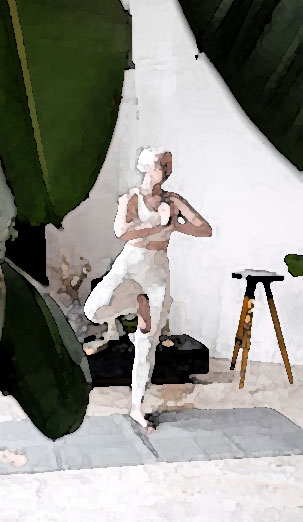
Week after week, I arrived a few minutes early to get a spot with a clear view of our instructor, Nina. As weeks and then months passed, I gained confidence in my ability to hold each pose. I also felt my body getting stronger. Who would have imagined that decades into this life I could squat like a child raised in India for minutes at a time, then stand without needing to press my palms against the floor? Yes, I still had trouble stretching my foot from behind to the front and rising into a lunge. But I managed a wobbly transition to the pose. Happily, the balance postures, like tree pose, with one leg pressed against the opposite thigh, came easily.
I loved it when we stretched gently from pose to pose, flowing between warrior one, with one leg bent and arms overhead, to warrior two, with arms out to each side. Gliding from posture to posture felt like swimming in salt water, doing the breaststroke with little effort at all.
Months into the practice, yoga began to stream out from the large, mirrored studio into my life. It occurred to me then that I was learning how to navigate aging and death, grief and loss, which our culture tries to deny. One key was the strength I was building in every second I held the plank pose, my body balanced horizontally, inches above the mat, or chair pose, in a low squat, palms pressed in front of my heart.
Nearly opposite was flexibility, which came more easily in yoga class than in the rest of my life. More than strength, this was the tool I needed to make a new life, after three decades with the beloved partner I had lost.
When Nina kindly offered that we could use a strap or grab a pant leg instead of an ankle, I blissfully reached my fingers down to my toes. Back home facing the latest catastrophe – a kitchen cabinet door suddenly come loose – which made me desperately yearn for my smart patient husband who could repair anything, I put my yoga flexibility into practice, calmly analyzing the problem and fixing it. Instead of stubbornly clinging to the life I’d once had, married to a man who, like me, loved to travel and explore, I searched and found opportunities to visit places I’d never been on fun group trips.
And then there was acceptance, the greatest yoga lesson of all.
“Don’t do anything your doctor tells you not to do,” Nina warned before every class. In other words, accept your limitations, and in my case, accept your age.
Yet what I found in the room with the unforgiving wall of mirrors is that in some ways, age is a box that I can expand, depending on how I treat myself.
Yoga has taught me that when my body is treated well, it usually responds. Week after week, I squat. After holding the pose, I stand, roll my shoulders back, shake out my legs, and bring both arms to my sides. My feet stable, I turn my palms forward. I am now in mountain pose, a pose of quiet strength.
In stillness, I think how grateful I am for this life, even though I am now a widow alone. And I think how thankful I am for this body, which after so many years, still refuses to let me down.
Previously published in Living Our Blessings: Aging, Mortality & Gratitude
The Piker Press moderates all comments.
Click here for the commenting policy.