
Even at mid-day an icy chill froze the air in this part of the world, a mixed blessing to the nineteen men loping across the hard ground. At the onset of their journey, each day consisted of resting in the shade whenever the sun appeared above them, and rushing to cover as much ground as they could in the dark. It had been too hot to run for more than a few hours at a time then, even though there were miles to cover. In the dark it was difficult not to trip over a rock, or to stumble into the man in front of you who had slowed in case that strange sound in the night turned out to be a predator with his scent in its nostrils. The Nomi men kept their own snouts in the air as they moved, but the cold seemed to dampen the smells of the world and those that did reach them were alien.
The cold air comforting their moving bodies allowed the nineteen Nomi to cover twenty miles a day. It was unusual to feel cooled by the air. Pleasant, even, until they stopped for the evening and the sweat drying on their skin chilled their good moods.
Whenever the sun touched the mountains on the horizon, they stopped, and unpacked thick shirts woven from Tlim fiber and lined with thick Reeyan fur. The shirts irritated their skin but kept the frigid temperature at bay. It was a matter of choosing which discomfort you preferred, and the moment came for everyone when they opted for itch over shiver.
That moment came a little earlier each evening.
They camped near the river. More of a stream now, the higher they moved up the mountain. It offered clean water, and edible grasses, and the occasional fish. There were no fleshy insects digging through the hard cold earth, but the Nomi made do with the crunch of a few winged insects swarming near the water.
A pair of Nomi men volunteered to gather food each evening in a rotating schedule while the rest of the group set up camp. The scouts, Dimat and Yuenk, the youngest in the group, volunteered often, eager to impress the more experienced hunters, who were in turn happy to take weight off their feet and relax while the young men shouldered the extra work.
The camp had settled into a peaceful quiet when the scouts strolled into the firelight from the darkness one night, laughing in triumph. They heaved a large hooved animal carcass into the middle of the camp. Reinal, a warrior with years of experience hunting herds of Kraginyi back home, set to work preparing the meat.
Ruing’y clapped the shoulders of Dimat and Yuenk. “A good hunt.” The young warriors tried not to look pleased with themselves.
“Now get us some greens from the riverbanks,” Ruing’y said, while their smiles faded. “As much as you can carry. We need more than just meat; the men have been running all day.”
Much later, with empty stomachs sounding their complaints, the men watched the meat cook over a large fire while they nibbled on bitter water plants.
“You burn good food,” Kag’in said. He nodded towards the flames.
Ruing’y shook his head. “I know you want raw food. We all want our meat fresh, it’s the natural way. But you would not enjoy the uncooked taste of this particular beast.”
“You have eaten this animal before?”
Fat dripped from the meat, sizzling in the fire. Ruing’y shook his head again. “This animal is new to me. I have consumed other southern beasts though, and they are all unpleasant. Your stomach would not welcome this meat before it receives a proper cooking.”
Kag’in rolled a wide leaf into a cylinder and tossed it into his mouth. He shifted his sitting position and grimaced. “My body doesn’t welcome much of what I’ve been putting it through of late.” He spit a fleck of green into his hand. “Everything tastes bitter, the nights last too long, and I haven’t run so far day after day since I was a young scout myself.” Kag’in gestured to Yuenk, sitting against a log. Yuenk’s head nodded as he struggled to stay awake.
The men sat near the warmth of the fire trading stories of their wisdom and strength most nights, but the mood had grown subdued in the recent days. Some spoke of the comforts of home and of those who were waiting for their return.
“We covered many measures of ground,” Ruing’y said. “You should feel good about that. Everyone should feel pride from their accomplishments today,” he said a little louder. A few Nomi cheered. Some ducked their heads, embarrassed by the suggestion they might desire encouragement.
Kag’in swallowed a mouthful of greenery and chased it with a long gulp of water. “Don’t talk to me as though I were a fragile Mulmin. I complain about the way the cold makes my muscles ache. That is my right as an old man. It is not the same as suggesting I am unable to go on. I simply need a night of rest.”
“I will never doubt your strength again.” Ruing’y lowered his voice. “But now speak truth to me. Are the men near to giving up?”
“Nowhere near it. They experience some boredom, it is nothing more than that. They grow impatient for anything else to do beyond cover as much ground as possible during every waking minute.”
“I can’t wave my hands and wish and make something happen,” Ruing’y snapped. “We’ll find the Titita as soon as we enter their habitat. I don’t know how to make that happen any sooner.”
“I hear and I understand.” Kag’in spread his hands in a soothing gesture. “No one expects you to change the world. Be slower to anger.”
Ruing’y rubbed his forehead. “Apologies, my friend. It appears I’m in need of some rest, as well.”
A branch popped in the fire. “Do so now,” Kag’in said. “I can wake you when the meat is good and burned beyond all hope of flavor.”
“I thought you were the one who needed rest.”
“You thought right, I would gladly welcome extra time in my bed tonight. But you need it more.” Kag’in grinned. “I’m still likeable when I’m tired.”
* * *
The browned meat was, indeed, enjoyed by no one, but they wrapped it in greased leaves and divided the parcels amongst the men, and it fueled the group for three more days. And at the end of those three days the scouts returned before sundown to report the first signs of Titita, and everyone’s mood brightened.
Six of the hairy gray animals camped at the edge of the forest. By the size of the layout the camp was prepared to handle twice as many. Tents sat arranged in a circle, surrounding blood-stained wooden racks. Two of the racks stood empty. Fresh kills stretched across the other three. An enormous animal of some had been skinned, and two Titita worked to scrape the thick hide clean while another prepared the meat. The Nomi watched from the hilltop as the Titita carved handfuls of meat and pressed them between slabs of ice.
This is what they practiced for. It was why they left home in the first place. The Nomi took a moment to master their surprise and disgust and made ready.
Kag’in pointed to Larkin, Dimat, and Peng and signaled for them to circle behind the camp, in the woods. The rest of the men split into three groups and spread out.
A frigid wind ruffled the trees. The sound would act to mask their actions. Unfortunately, the Nomi were unaccustomed to such low temperatures, and their movements were stiff and less certain than they should have been. When one of the men slipped and fell to his knee, the Titita paused their work and scanned their surroundings. The Nomi men all stopped and dropped to the ground, but this was the Tititas’ environment. They knew how to look for something out of place.
Ruing’y tapped Kag’in on the arm. He placed his hand on his chest and pointed to the camp. Let me go to them. Kag’in frowned and, failing to devise a better plan, gestured for Ruing’y to go.
Feigning calm, Ruing’y stood and strolled towards the camp. The Titita watched him, wary. The smaller one cutting animal flesh, a female based on her size, held her butcher’s knife tightly in her hand at her side.
No one spoke or moved. Ruing’y stopped a few paces in front of them with his hands held out, palms up. Projecting his best innocent body language.
A stout Titita male with a mane of thick gray hair encircling his flattened face, spoke first. “Kannal azapamat freshek.” He is a Northron. “Kannal kuduruth. Falgath vistin ish pu’uk.” He must be lost. Watch him carefully.
An eastern mountain dialect. His words were flat and spoken at the back of the throat.
When the short Titita approached slowly, Ruing’y said, in the Titita’s language, “Yolayan ekudurii.” I am not lost.
The furry Titita jolted in surprise.
“I’ve been traveling for days, in fact, looking for you.”
The Titita woman with the metal knife took a step closer. “Who are you, and why are you looking for us?”
“Hakharan sent me,” Ruing’y said. He lowered his arms and shifted his weight from foot to foot, attracting their attention to his movements. He raised his voice to cover the sound of Nomi moving through the trees. “Do you know this man, Hakharan? He told me to find a hunting party, here, in this area. He tasked me to tell Pascha that his wife has birthed a girl.”
He turned to the stout Titita male who spoke. “Are you Pascha?”
“My name is not Pascha, Northron stranger.” The furry male beast scowled at Ruing’y. “How is it you speak our language?”
“You don’t recognize me?” Ruing’y asked. “I’m your clanmate, Pascha.”
“I am not Pascha!” the male shouted.
Ruing’y flicked his hand above his head as a signal. Peng and Dimat leapt into the camp and stabbed with their short spears, taking two of the Titita in the back. Larkin clubbed a third over the head and sent his neck snapping forward.
Before the Titita understood the nature of the attack, the three Nomi sprinted back to the woods. There they would wait to intercept of any Titita that happened to run for safety as the rest of the Nomi sprang from the sides and attacked, screaming.
None tried to escape. Ruing’y pulled a sharpened stake from inside his shirt and stabbed upward into the throat of the female, grabbing her knife as she fell. The remaining Titita had enough time to turn and face their attackers, then no more time at all.
* * *
The Nomi scouts located three more camps of increasing size as the hunters continued to make their way south. Guards stood ready outside the second and third camps. Word of the Nomi hunt spread among the Titita. One of the beasts that had been away when the Nomi attacked had sent word, maybe.
It made no difference. The Nomi were fast, and trained, and brutal. A fat sluggish Titita was no threat to a lean Nomic warrior.
“Do we not wish to capture one?” Larkin asked one evening. “As I understood, we are to kill those that we find after we interrogate it.”
Ruing’y arranged his blanket, trying to find the least miserable spot to sleep on the frozen ground. “We interrogate those who will have something to tell us.”
“How do you know none of these Titita had anything useful to say?”
“These are hunting parties, like us. No, don’t smile. I know they are not like us. They hunt in their own way.” Ruing’y lay down on his blanket and grimaced, turned on his side and faced Larkin. “You’ll see,” he said before closing his eyes.
* * *
The scouts reported on a larger party one morning.
“There are forty,” Dimat said. “Possibly more. None of them appear to be on alert.”
They crawled to the top of hill and peered over the edge of a cliff where small waterfalls trickled into a frigid lake below. A wide flat plain stretched next to the lake, dotted with Titita. Dimat gestured to some of the animals, talking and laughing with each other.
Dimat gave Ruing’y a confused look.
“This is not a hunting party,” Ruing’y explained. “This is a family.”
Kag’in whispered, “We kill them anyway.”
Titita looked up in calm expectation as the Nomi attacked. They expected us to be their own kind, returning with meat. Ruing’y listened to their words of surprise and watched how the animals turned instinctively to the cliff. He approached the base of the cliff while the slaughter progressed behind him. A cave opening lay open near one of the waterfalls.
It was warmer inside the shallow cavern. The air smelled of smoke and animal musk. An elderly Titita female sat on a bed of animal furs.
She watched him approach and nodded. “Too far north after all.”
Larkin stepped in behind Ruing’y, panting, breath streaming from his nostril flaps in jets of white vapor. His pupils were dilated.
“Is this your kill, Ruing’y?” Larkin asked, poised on the balls of his feet.
Ruing’y placed a hand on the chest of the young Nomi. “This is mine,” he said.
A stillness filled the cave. Only the sound of Larkin’s breathing disturbed the quiet. Even the battle cries from outside were muffled, and already fading to a quick end. The old Titita watched, giving no indication whether she understood the Nomi men.
“Your hunting parties are gone,” Ruing’y said, in the Tititan eastern dialect.
The old Titita blinked. “We have no hunting party,” she said. “We make clothing. Other families give us meat in exchange.”
“There will be no more meat for trade.”
“A shame, that. I do love a good meal.” A smile opened the female’s flattened face, exposing sharp brown teeth. “Although I doubt whether we will be in much of a position to trade anything, soon enough.”
“Are you surprised? Did you think you could enter our lands with no fight? Did you think you could push us out?”
The Titita said, “Who is trying to push you out?”
Ruing’y snorted. “We have found your kind in our hills. On our beaches where we fish.”
“Yes. Yes, my people are moving north. I don’t deny that. The weather grows cold and dry, and we are searching for new places to live so that we might survive. That does not mean we are trying to take over your lands. We don’t hunt the same animals; we eat few of the same plants. We won’t cause you to go hungry. Is our presence an offense to you? Is our existence cause for hatred?”
Triumphant cheers replaced the last dying sounds of battle.
“That was your family,” Ruing’y said. “How many more of them are there?”
The Titita shook her head. “You’ll find no more here.”
“Your kind lives in large extended tribes. I doubt that group included everyone.”
“You know our kind?” The elderly Titita searched Ruing’y’s face.
Ruing’y grabbed the animal by one stunted, flabby arm and pulled her to her feet. Larkin followed as they left the cave and stepped out into the open air. Tiny crystals of ice stirred in the wind.
Nomi watched in silence as Ruing’y flung the Titita against an old tree stump. “Tie her to that,” he said to no one in particular.
* * *
It was the first time since the mission began that the party stayed in one place for more than a day, and the men grew restless now that they stopped moving. The Titita female didn’t speak, only watched them sleep and eat.
Kag’in pulled his guide aside at the end of the second day. “My friend. Do you believe there are others coming this way?”
Ruing’y ate his dinner standing in front of the bound animal, making a show of enjoying the food. “Are your family members going to join you?” he asked in Nomic. There were no signs of reaction on her flat, furred face.
To Kag’in, he said, “I don’t know, any that were going to join should have returned by now.” The old beast watched him talk. “Their families don’t like to be separated for long. They don’t travel far. Except when they travel into our lands, isn’t that right?” Ruing’y leaned forward and chewed on the last piece of meat from his dinner.
Most leaves and grasses were inedible to Titita, who tended to eat fatty game and root vegetables for their meals. Still, she should be hungry by now. Hungry and tired and sore, and ready to be helpful if it meant a bite of food.
“Where are the rest of your family members?” Ruing’y asked in the female’s dialect.
She spoke in a dry, cracked voice. “As I told you, there are no more.”
“That would mean your clan was very small.”
“The world is changing. Our grounds have grown dry. My city, where we lived when I was a child, has frozen under great shelves of ice. We are homeless, and we are few in number.”
Ruing’y laughed. “My people live on the land. We don’t limit ourselves to a place, we remain ready for anything. You ignorant beasts should learn from us not to be so dependent on one area.”
The female tried to adjust against her ropes, gave up. “You speak my language very well.”
“Your language is simple. So much simpler than ours. Any of my brothers could learn it in a day.”
“And yet none of them do.”
* * *
One hand freed, her wrist red with welts, the Titita female reached out a trembling hand and accepted a cup of water. After a brief hesitation she drained the cup, grimacing with each swallow. She dabbed at her cracked lips.
The female stared into the cup. “I suppose if you were going to poison me, there would be no stopping you.”
“Tell me why your tribe lives this far north.”
The female sighed. “I have told you many times. The world cools. Our hunting grounds are bare. Our cities are dead.”
“Your world is always cold.”
“Our world fluctuates. And we like it colder than you, yes, but not so cold that nothing can live.”
“You seem to think your people understand the world so much better than we know it. Do you think you can see things we cannot?”
“My people are scientists, and it is true that we observe. I was myself a teacher of the sciences for many years. We have evidence that the world, the entire world, yours and mine and all parts beyond, experiences periods of great freezing. We have studied the weather and the soil for thousands of years and witness a repeating pattern. If we didn’t move, we would die.”
“You move north, and you die anyway.”
The female tapped her empty cup against her leg, staring at Ruing’y. “Why do you hate us? I beg you to give me an honest answer.”
Ruing’y took the cup from the woman’s hand. “Don’t play the fool with me. This is the way it has always been. There can only be one dominant species, and we were both given the world and told to fight for it by the old ones.”
“No. I don’t believe that. Few of my people do. I think that even you don’t believe the old stories.”
Ruing’y looped the rope around her wrist. “Think what you want.”
* * *
The air was dry, the old woman was right about that. The night sky glowed sharp and clear, with no clouds to dim the stars.
The old Titita looked bruised from lack of sleep. Ruing’y would not let her realize how badly he also wanted to rest. She wouldn’t see him tire.
“You’re wrong about the way of the world and our place in it,” she said. “It hasn’t always been as you describe it.”
“Oh? You know better?”
“My people used to think much the same way about you Northrons. That you were born as competition. But ancient tales from many generations ago also tell us how we had the same parents, once. Those stories were told over and again, until they captured our hearts. We believe you and I are the same species.”
Ruing’y spat on the ground.
“Listen to what I say.” The female rubbed at her pale watery eyes and leaned forward as much as her restraints allowed. “We study life of all types. There are reasons to believe we are from the same ancestors.”
“We look nothing alike,” Ruing’y said. “I am not short; I am not slow. I am neither furry nor fat.”
“Yet you are more similar to me in a hundred ways than you are to this tree, or to that insect. I hear how well you speak my language, with such clarity. Others of your people that have spoken our language, they are so nasal. Their words sound as though they are gagging the speaker.”
“Your point?”
“Do you not think it odd that two different species could speak to each other like this? With so much understanding and nuance?”
Ruing’y ran his palm along the grey lichen covering the ground. “My people are closer to nature than yours. We speak to the animals. We speak to the plants, and the wind. This is nothing.”
“You may speak to the wind, but it is not in the same way you and I speak to one another. The wind can’t tell you that you sound nasal or that you speak with an accent.” The old woman smiled. “The wind doesn’t know what an accent is.”
“You don’t know what the wind can tell me.”
“The wind can’t tell you that you speak in metaphors.”
* * *
“Have you seen our cities?” The female’s words were muffled by a mouth full of dried meat. Kag’in watched the Titita and Ruing’y, not hiding his disapproval. The small day-old bunch of grass and fruits sat untouched on the ground near her feet.
“I have seen a few of them.”
“You are, what, twenty years of age?” The Titita winced, struggling to swallow the tough meat.
“I’ve seen twice as many years as that.”
“Ah, of course. It is difficult for me to tell ages with your kind. Even forty years, or fifty, you must not have seen the old cities, where we lived for a hundred generations. Where we’ve been living, the new cities, although they suffice, are a shadow of the places that thrived before.”
“So you say.”
The old woman cocked her head to the side. “Your people, they celebrate the season of your birth every year, I have heard.”
“And where could you have heard such a thing?”
“You are not my first Northron encounter. Your people kidnap mine. Sometimes we do the same to you. Many of your tribes, they told me, the family elders tattoo a dot, or line, or some other signifier of each year passing.”
Ruing’y stood and pulled his pant leg up, revealing a jagged pattern marking his shin. He ran his finger along the design.
“Yes,” the old woman said. “I saw a glimpse earlier. Curious, though, there are far fewer than forty marks.”
“The other leg continues,” Ruing’y said, jerking his pants leg back down.
“May I see it?”
“Explain why.”
“You’ve heard of our cities. You speak my tribe’s language. You know so much about us.” The woman tore another piece of meat with her teeth and chewed.
“Yes? I know much about many things.”
“If you were living with us, as a prisoner or for some other reason, would you still get a mark for your season? Or would you be missing some of your years when you returned?”
Ruing’y took the meat from her hand. “You’ve eaten enough.”
“My people also have a tradition that marks the skin. When two decide to join for life, they will mark their palms with half circles and press them together during a bonding ceremony to form a full moon.”
“I also know this.” Ruing’y threw the meat to the ground and kicked dirt over it.
“Even if someone from outside the tribe bonded to one of us, they would be asked to accept the mark as well...” The woman trailed off, watching him.
Ruing’y held two unmarked palms in front of the woman’s face. He slapped her with one, then the other.
“Ah well.” She licked her split lip and spat blood onto the ground. “It was just a theory.”
* * *
“When will you kill me?”
Ruing’y opened his eyes, not certain when they had closed. It was dark again. It was dark so much of the time. He said, “I’ll set you free when you give me something useful. Something that isn’t more of your lies.”
The old woman looked up at the sky where the stars smeared across the night and closed her eyes. She said, “Can I show you something?”
“Tell me what it is,” he said.
“Please,” the woman said. “It’s better if I show you.”
After a moment’s consideration, Ruing’y hacked the rope away and pulled the woman to her feet. She took some time to get her legs working, and only by leaning heavily on her captor did she lead him back to the waterfall.
They entered a second cave, obscured by trees. The Nomi men watched from afar, mumbling to each other, making no move to join them.
The cave ran deep into the mountainside. The air warmed and thickened as they walked down a narrow corridor. By the time Ruing’y’s eyes had adjusted to the darkness, there was light again, flickering off the walls.
A large, dry cavern opened in front of them, filled with torchlight, furs, and meat. It smelled so strong Ruing’y had to cover his own snout with an arm before he could enter.
Three adult Titita watched them. A younger female moved to protect something Ruing’y couldn’t see. The other two males backed away and fidgeted, watching him.
“Popaghala?” the younger female said. “Who is this?”
“Please remain still, Shosacham,” the old woman sighed. “They have destroyed everything else. I am sorry.”
One of the males snarled, “And you showed this murderous Northron where we hid? Are we to kill him?”
“You can try, if you wish,” Ruing’y said. He drew a knife from the sheath at his thigh and set his feet in an attacking stance.
“Stop, please.” The old woman, Popaghala, held her hands out. “Gasfrehes, I’m sorry, he needs to see the little one. It’s the only way he’ll believe.”
“No!” Shosacham turned and picked up something from behind her and held it to her chest. As the thing woke and found itself no longer in the pile of comfortable furs, it began to make small grunting noises that grew into muffled howls of disapproval.
A baby.
The baby’s wails made Ruiung’y’s skin itch. “Show me the child.”
Shosacham squeezed her eyes shut and shook her head, turning away. Ruing’y grabbed her arm and forced her to face him. He pulled a wrapped fur away to see a head of sparse hair. The baby’s face was narrow for a Titita, and not so flattened. Its skin was the color of light brown clay, contrasted against the paleness of its mother.
“You see, don’t you?” Popaghala asked.
Ruing’y shoved the mother away.
“You see what he is.” The old woman eased herself onto a pile of furs. “A man like you could not have a child with a tree or with the wind. You could not create a child with any other animal, the way this child was created.”
Ruing’y could not remember seeing or hearing anyone else enter, yet Larkin and Dimat were there, flanking him. He pointed to the baby. “That thing is an unnatural abomination.”
“She is the very definition of natural!” Popaghala said. “This is what I am trying to explain.” She took a moment, considering.
“There are others,” she said.
Ruing’y rubbed at the pulse behind his eyes. The knife twisted in his hand.
“Where?”
“Not here. In other camps. Northrons have bonded or forced a child into a Southron mother before moving on. Sometimes, not often, a Northron is taken prisoner and becomes part of the tribe.” Popaghala lowered her voice. “Is it possible you already know well of this?”
The metal knife was so cold it burned in his palm. Ruing’y turned the blade to see his reflection blurred along its length.
“Where is this child’s father?” he asked.
“Gone,” Shosacham said.
“He was with us for only a short time,” Popaghala said. “Most do leave, out of fear.” She shook her head. “It is not us that they fear.”
Another Nomi man walked into the cave and froze. Ruing’y heard the footsteps but did not turn to see who it was. Shosacham began to cry.
Popaghala struggled to her feet. “Some do stay,” she said, stroking Shosacham’s thick gray hair. “They even grow happy. They tell us they found peace. We do not send them away. They tell us our people are not welcome among your tribes, but some hear whispers of secret Northron pairings. My people living in the shadows with your kind.”
“Nothing but filthy lies,” spat Ruing’y. It was Kag’in, blocking the cave entrance. He watched the scene with wide open eyes.
“Perhaps.” Popaghala tucked a fur wrapping tighter around the baby. “This is not the first mixed child, nor will she be the last. Some such children have even grown up and had children of their own. If you let us leave, I could show you.”
A red line opened her throat as Ruing’y slashed his knife. Blood sprayed over the baby and its mother. Both screamed.
Before Ruing’y could give a signal, Kag’in stabbed his own knife into the temple of one of the Titita men. Ruing’y turned from the crumpling mother and child and stepped out of the cavern. Dimat had pinned the remaining Titita male down, and Larkin used a rock to flatten his skull.
“Ruing’y?” Kag’in stood over the female, who was trying to wrap herself around her child.
“Kill them,” Ruing’y said. “Kill that thing in her arms.”
Kag’in stood silent, a questioning expression on his face.
“Strike now!” Ruing’y turned to Larkin and Dimat. “One of you, kill them!”
“Nyam nimekg Ruing’y?” Kag’in said. What should we do?
Ruing’y heard the strange nasal words from Kag’in and wondered how long it had been since he spoke his native tongue. Ruing’y tried to repeat his command in their common language but for some reason his mouth couldn’t form the words.
He left the cave, crossed the length of the camp, and kept walking into the cold of the southern world.
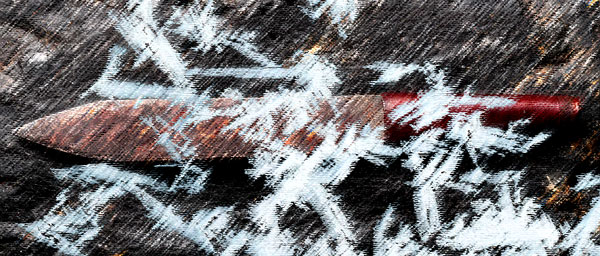
Image credit: Stone Knife Stock photos by Vecteezy
More articles by Sean MacKendrick →
More articles in the short fiction genre →
All comments are moderated.
Commenting policy