
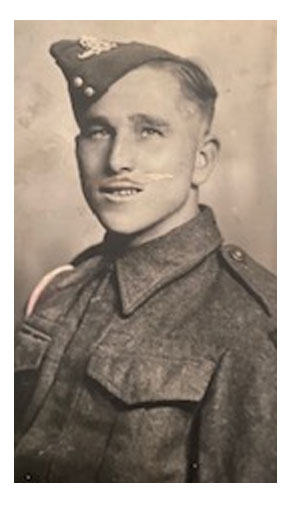
When my father and I pulled up at grandfather’s thatched cottage he was waiting for us outside, in his old green tweed jacket and matching shooting cap. Leaning forwards on his walking stick, to take the weight off his prosthetic right leg, he frowned at my father’s long shiny black Sierra. At his feet lay the tools required for my afternoon chores – a fork, some creosote and brushes. The weather-worn fence enclosing his tumbledown house and allotment stooped towards his hunched back. All around, wheat fields stretched out towards the big, cloudy, Bedfordshire sky.
As my father and I alighted, grandfather shouted in a stagy cockney voice:
‘Cor! That is a la-di-da motor!’
The sallow skin on my father’s face – that was stretched so tightly across his chiselled features it looked like it might split – seemed to loosen as his thin lips curled into a smile. His balding, bobbling egghead shone in the sudden sunlight.
‘It’s the new, 1988 2.8 Ghia hatchback.’
My father tiptoed over to grandfather, dodging the puddles in the drive; I loitered by the car. Halting in front of the old man, father flicked imaginary dust off his charcoal pin-striped suit, then bobbed up and down on the balls of his feet, as though showing off his superior height and vigour. Yet grandfather’s squat solidity made my father look scrawny and frail, while his immaculate office uniform seemed uncomfortably stiff – all angles and knife-edge creases – next to grandfather’s snug and shabby country outfit.
‘A double-barrelled charabanc, eh!’, grandfather whistled, ‘But ain’t it too low for you boy? You’re getting that tall, you’ll soon have to kneel down to get inside it.’
Watching them try to stare each other out, a warm sensation welled up inside me; sweat formed between the prickly hairs sprouting under my armpits. I’d never seen anyone goad my father so openly. I wondered what other funny things grandfather would say about him during our afternoon together.
My father jerked his large gold omega wristwatch towards his bony face.
‘What’s the time Mr. Wolf?’ Grandfather imitated a boy’s voice, ‘55 BC?’
‘I beg your pardon?’ My father murmured, blinking at the gleaming dial.
‘Gives the hour in Latin, don’t it,’ Grandfather said, ‘and I thought it might be getting on for …’, he made a V-sign at father with his left hand, then – letting go of his stick momentarily – doubled the rude gesture with his right, ‘V V BC’.
I smiled at grandfather, faintly, quickly, fearing my father would notice.
‘It was in 55BC’, grandfather carried on, in a posh, BBC historian’s voice, ‘that Caesar washed up in Albion; “It looks like rain,” he said to Cleo, who’d come along to bring a bit of glamour to the place; “Hail, Caesar,” she replied.’
I let out a titter, to let grandfather know whose side I was on in the family feud, while hoping my father wouldn’t hear it above the noise of the traffic on the Luton Road behind us.
‘FYI,’ Father snapped, ‘it’s fourteen hundred hours, on the eighth of the eighth, eighty eight’.
‘8888! Well, blast my luck!’ Grandfather howled, ‘You wait all your life for two fat ladies, then four come along together, when you’ve haven’t even got enough lead in your pencil for one of them.’
‘Language father!’ Father squawked, ‘the boy’s only fifteen!’ (he needn’t have worried; I didn’t get the joke). ’14-hundred hours, gives him 250 daylight minutes, in decent weather conditions too – ample time and circumstances for such a trifling undertaking;’ – he gestured towards the implements on the ground – ‘so let’s say six thirty.’
‘“Six thirty!” Major-Gineral Sir.’ Grandfather saluted. ‘We’ve had an awful lot of weather this summer, but I can confirm, paregorically, that it will indeed be a top-hole afternoon for the race.’
‘To which race are you alluding?’ My father asked automatically, wincing as soon as he’d said the words.
Grandfather poked him in the thigh with the grubby rubber tip of his walking stick; a flake of chocolaty soil came off it, and clung to my father’s trousers. I felt the prod, the texture of the grainy mud, and took pleasure in them, as grandfather bellowed.
‘The bleeding human race, of course; though that doesn’t concern you much does it!’
My father shook his head, then about turned and marched to the car.
‘Company, halt!’
Grandfather’s command stunned his son, mid-stride: his back knee remained in the air; puddle water dripped down from his Darth-Vader shiny shoe.
‘A pisspodical question:’ grandfather said, ‘how far would you have got if I hadn’t stopped you?’
Chuckling, I took a step back from the car, into a puddle, soaking and soiling the red Converse mum had given me for my fifteenth birthday. Blanking me, father paced over to the driver’s door, threw it open, flung himself inside, revved up, and hurtled down the drive, spraying muddy water and gravel all around the car.
As I watched him force his way into the traffic and speed off towards his office in Bedford, I wondered why he was letting me work with grandfather, who’d presumably asked for my help with manual tasks he could no longer perform. My father couldn’t have agreed out of charity or even duty. He kept his distance from his father, and boasted he’d never re-entered his childhood home after moving out on becoming a trainee solicitor. I put their bad blood down to a character clash – relaxed v. rigid, eternal youth v. premature old age. My father made sure I rarely saw my grandfather, so I wouldn’t – in his words – be ‘exposed to his squaddie language and morals’ or distracted from ‘getting on with getting on’. By this he meant excelling at my forthcoming GCSEs, then goose-stepping down the long academic path he’d marked out, that would lead me, eventually, to a lucrative legal career, which would allow me to acquire a ‘Victorian pile in Bedford, and a place at its old school’ for his grandson, ‘Smith the Younger’. My success in life would, however, depend on whether I was ‘able and willing’ – ‘for, as Mrs Thatcher says: “life is a beer jug: what you put into it, is what you’ll get out of it.”’
Still smiling at father’s retreat, I turned to grandfather, imagining he’d be smiling too. But his face was blank and his head bowed:
‘I’m surprised Lord Pooter remembered the way here.’
His voice was deep, slow, monotone. It no longer evoked London, but seemed to echo the Home-Counties countryside around us, which he’d worked on, as a gamekeeper, beater, bee-keeper and odd-job, cash-in-hand man for the remnants of the local gentry, after he’d returned from India and the war.
I tottered towards him, stopped a metre away, didn’t know what to say, just stood there staring at the flecks of Brylcreem in the grey hairs poking out beneath his tweed cap. I wondered if the hat was glued to his scalp by the lotion, because it didn’t move a millimetre when he started shaking his head. I could smell the sickly-sweet hair cream, along with a savoury whiff of roast dinners and piped tobacco that came off his clothes. I wanted to embrace him, but his pungent odour, and sunken posture, made me keep my distance. I shifted my weight between my feet, and examined his face. It reminded me of the Edwardian shillings I’d once seen in his coin collection – small, round, browned with age, it was criss-crossed with wrinkles so deep they looked like scratches. His short grey moustache was as bristly as a shoe brush, his hazel eyes were beady, restless.
I held out a shaky hand. He stared at it, shook himself, then bent down to pick up the fork at his feet, with an agility remarkable for a man with only one good leg. Placing its socket into my hand, he shook the handle, said ‘how do’, then grabbed it back and hurled it to me. I half-caught it, then let it slip through my butterfingers. I’d been distracted by the sight of his huge hands, which had deep furrows and tufts of grassy hair that reminded me of the fields around us.
Grandfather tutted at my fumble then stood to attention. Closing one eye, he put his right arm inside his jacket.
‘England expects, Captain: first, you have the honour of digging for queen, country, and my winter parsnips, then the inestimable pleasure of tarring the fence.’
After swivelling round carefully on his stick, he led the way inside the creaking gate, planting his crutch and plastic right leg a couple of feet ahead of his body, then hopping towards them with his good leg, to catch up. In slow, unsteady motion we turned left, and shambled along the front of his crumbling, off-white cottage, towards the adjoining allotment. The soil of the small oblong plot was dry, after the hot days that had followed the summer harvesting. Propping up the irregular, semi-circular fence were leaning towers of bricks and the rusty tools which grandfather’s grandfather had used when he’d put up the cottage. As we shuffled towards the cracked sundial in the middle of the patch, I tried to keep to grandfather’s stuttering pace, to avoid overtaking and thereby embarrassing him, but the only way I could do so was by imitating his awkward gait, which proved so tricky, with a fork in my hands, that I tripped up, toppled over.
‘You great turnip!’ grandfather growled. ‘Lord knows what mischief you’ll do yourself when you start digging!’
I got up, covered in soil and blushes, brushed the mud off my Smiths T-shirt and 501s, and laughed at my clumsiness. I hoped grandfather would laugh too, but the glare he gave me felt like a stab in my heart. Holding back the tears, I clenched my teeth, gripped the fork, started digging.
I soon became so absorbed in the job, and enthused by the open-air exercise, that I forgot about his frostiness. Over the previous six weeks of the sunny summer vacation, my father had made me study every day. After wading through GCSE textbooks on Science and Philosophy, all by myself, I reckoned that doing straightforward manual chores outside with grandfather would be a holiday.
It was indeed fun to turn over the earth, and reveal its moist texture and smell, as the sun and wind warmed and cooled me by turns. The topsoil was hard, and my arms and lower back soon started aching, but the work was invigorating, in a good cause, and in what might yet turn out to be good company. Even if my grandfather and I didn’t bond as well as I hoped we would, I was sure I’d be entertained by his old-fashioned curses, and trademark one-liners.
And yet, as grandfather scrutinized my digging, he stayed tight-lipped. After a while he shook his head:
‘You ain’t doing that right! Put your back into it more, and grimace while you’re at it; the art of digging is all in the way you hold your mouth.’
I sensed exaggeration in his angry tone, so tried not to take him too seriously, though the tutting that followed his words suggested they might not be entirely a joke either. I made the adjustments he recommended, but they didn’t make much difference to my digging, or his opinion of it.
‘You want to beef Wellington up boy – that’s your trouble – look at you, you’re that thin, you have to stand in the same place twice just to cast a shadow.’
Twenty minutes, and as many sighs later, my grandfather cast his walking stick aside, and wrenched the fork out of my blistering hands. Positioning his artificial leg on the step, then bending down to clasp the collar, he used his upper-body weight to press the tool deeper into the soil than I’d gone.
‘There! I’ve got a wooden leg; housemaid’s knee in my good one; and flaming piles into the bargain, and I can still do better than you! More fool me for agreeing when your mother begged me to give her fancy boy the benefit of my experience for an afternoon.’
So our afternoon together had been mum’s idea, not his! Not only did he not want me there, after discovering I wasn’t a champion digger – he’d never wanted me to come in the first place! I was so angry that I spat on the ground between us.
‘Atta boy!’ he guffawed, ‘We’ll make a man of you yet, Gunga Din! And now you’ve got that weight off your mind – dig, dig, dig!’
But my aches, and his revelation that mum had organised our afternoon together, gave me a better idea.
‘Can I switch to painting the fence for a while? Mum said she wants you to teach me, so I can do the fence at home.’
My grandfather muttered ‘you ain’t as dumb as you look’ then assumed his Nelson pose.
‘This is most irregular; your first duty is to obey orders implicitly; however, as it’s your love-li-licious mother’s wish, and as I’m liable to get the pox watching you make a balls up of my beautiful garden, I shall make an (h)exception.’
Creosoting the fence was a less demanding, more enjoyable job. I loved the smoky asphalt smell of the chocolate-coloured liquid, and the way the fence sighed with pleasure when I slapped it on. However, an hour in, the task became boring; so did grandfather’s running criticisms of my painting. To distract him, I asked whether he admired ‘the Iron Lady’ as much as my father, or disliked her as I did (I’d recently joined Labour, using my birthday money for the fee).
‘Maggie ain’t no lady.’ Grandfather snarled, ‘It gives my arse a sore throat listening to her stuck-up-start accent. She’s as bad as that perverted snob polytrician, Tony Bent. Old England’s gone to the dog-eat-dogs.’
Breaking off, he shook his stick at the fence.
‘Well blow me if you haven’t gone and missed another bit! It looks like someone pissed on that panel. All that passed-your-bedtime story reading is putting your eyes out boy! Squander good shut-eye time at your age, and you’ll be blind long before you get to mine.’
Mum must have asked him to discourage my nocturnal book binges, which had begun six months previously when I’d borrowed The Complete Dickens from the library, and read it through twice. I could stomach grandfather slagging off my work, and even a Labour politician I admired, but I couldn’t let him imply reading my beloved ‘Boz’ was bad for me.
‘But you must love Dickens, grandfather! He’s the best of English literature.’
‘I don’t need books.’ He shrugged, ‘Life’s good enough for me.’
I couldn’t think of an answer, so went back to the fence.
After another thirty minutes I finally finished the dull job, and grandfather called ‘tea time’. I volunteered to help carry out the refreshments, but he gave me another death stare.
As he trudged off to the cottage, I stretched out on the earth and watched the clouds drift by like cartoon ghosts. I still felt relieved to be away from my textbooks, but the excitement I’d felt about being with grandfather had disappeared. He was no more interested in me, or my interests, than my father, and just as eager to run me down. Turning over to smell the moist earth, I grazed my nose on an animal bone sticking out of it. Even grandfather’s land seemed to snub me.
Hearing the cottage door groan open, I got up quickly. Grandfather emerged, carrying a large tray loaded with biscuits and mugs, in his shaky left hand. Three bikkies and two ‘damns’ were dropped on his slow way over to the sundial, where he set down the tray.
We worked our way in silence through a pile of jammy dodgers and custard creams, to reveal the image of an Indian girl in a sari carrying a basket of Lipton’s tea leaves, on the tray. She looked as sweet as the jam that stuck to my palate but completely out of place on a Bedfordshire allotment. We swigged sugary milky Darjeeling out of matching ‘1953 Coronation’ mugs, decorated, according to grandfather, with ‘young Liz, in her Junior Commander’s regimentals’, flanked by British and English flags. On finishing his drink, he dabbed his moustache with his pocket handkerchief, cleared his throat, and put on a presenter’s voice.
‘We shall now provide light entertainment for the troops.’
The announcement reminded me he’d been in the Indian entertainment corps during the war (when Mum had mentioned this at home one lunchtime, father had commented – ‘yes, the daredevil saw a lot of action at the back end of that pantomime horse!’). Grandfather began by firing off one-liners: ‘There’s an awful lot of land around here and, the funny thing is, it’s all outside.’ Most of the quips were familiar, all of them made me giggle, though he didn’t give me any time to laugh before moving on to the next one. I felt amused but excluded – as though I was on my own at the back of an audience of boisterous soldiers. As he spoke, he didn’t look at me but followed the flight of some chirpy sparrows. Apart from his roving, shiny eyes, his face was expressionless and still, so was his body. It didn’t seem wooden and stiff though, like my father’s, but stony and hard.
After a wisecrack about ‘her Majesty’s visit to the Queen’, he tilted back and forth on his stick.
‘The next song was going to be a dance sung by a female lady, but I’m afraid Ada’s come down with gouty balls, so you’ll have to make do with yours truly…’.
He introduced ‘The Baby’s Name’, a ditty about the christening of a child born during ‘The Boer War: act two’ and named after its battles and leaders. Apparently, it had been sung by English soldiers in South Africa, and then later in the world wars, ‘to keep their peckers up’. Raising his right arm, he warbled in a funny falsetto:
She's got Transvaal on the brain
And when the parson asked our sprog’s title
This was her recital:
‘The Baby’s name is: Kitchener, Colenso, Kruger,
Cronje, Capetown, Mafeking, Ladysmith, Majuba,
Union Jack, Fighting Mac, Lyddite, Pretoria, Blobbs.’
I applauded his skilful singing, and because the song seemed to poke fun at cheap and nasty nationalism. I was also eager to warm myself up. It wasn’t only the rising wind or the pause in work that was giving me goose bumps. It was also his jokey references to brutal imperialist war and the memory they’d brought me of photographs I’d seen in a history book – of malnourished English troops in the Transvaal, and emaciated Boer women and children in British concentration camps.
‘That was always the showstopper when I performed it in Poona.’
It was the first time I’d heard him refer to his wartime experiences.
‘What was Poona like?’ I asked. ‘Does it still exist?’
His smile fell off his face, his brow tightened into a frown.
‘Don’t ask me about the war!’ He growled, ‘It’s horrible. It’s seeing your mates being killed by some poor bastard who’s scared of being killed hiself… ’.
He looked away quickly, then added in his Alf Garnett voice:
‘Anyway, I should never ‘ave ‘anded in me bleeding papers; if I’d ‘ave stayed on I’d be a Field Marshall by now.’
He turned towards the road and wolf-whistled. An elderly lady in a mac was ambling along the pavement. He pointed his stick at her.
‘See that old girl walking by with a lisp? She was married to the late Jimmy Hancock, who couldn’t see straight on account of his boss-eyes, which was just as well because she didn’t half put herself about the village. We referred to her, affectionately, as “Hancock’s Half Hour.”’
I’d never heard saucy talk from an adult before, and I blushed.
‘In those days,’ he grinned, ‘I was often on the job, on an odd job. If the gentleman of the manor was out shooting, its lady might request a bit of hot-cock roll in exchange for the rolls her maid gave me for luncheon.’
He told ‘amorous adventures’ for ten minutes – long enough for me to get used to, if not entirely comfortable with, his bawdiness. Despite my embarrassment, it was a relief to hear a grown-up talk about sex frankly and flippantly. A year previously my father had given me a stammering lecture on ‘the facts of life’, which had contained few relevant facts and no life whatsoever. At fifteen, sex was still a great and sorrowful mystery to me, but grandfather’s smutty tales took some of the sorrow and mysteriousness out of it.
‘Once I wondered where all my oomph came from;’ he stared at his crotch, ‘now I wonder where it’s all bleeding gone; it takes all my effort these days just to raise an eyebrow. Enjoy the old chap while you can boy; cos if you don’t, I’ll show you my balls.’
For a second I was alarmed, but then realised he was joking, even before he smiled.
‘You’ll be alright boy.’
Then the upturned corners of his mouth flattened, gradually, and his eyes darkened, watered and looked down:
‘Your father…’, he mumbled, ‘your father…’.
After a while he shrugged.
‘Your father is so mean, he’d skin a fart… but I daresay it’s my fault. I rather liked the idea of the prig soliciting... and bettering his-self… Anyway, there no work for him here,’ he gestured towards the surrounding fields, ‘after Commie Clem Atlee did for the squirearchy; and nothing for him at home after his dear mother passed.’
Wiping his eyes with a hanky, he muttered ‘Now what’s the use of a moustache if it don’t keep the dust out of your eyes?’.
He lifted an old scratched silver watch out of his jacket by its fob and opened it in his large-wrinkled palm. He tapped it several times, listened to it, and shook it, but its second hand wouldn’t budge – and hadn’t, apparently, since ten o’clock (either that morning or some other day). In the end he shrugged, pocketed it, then craned his neck and looked at the sundial.
‘Blimey – the witching hour is almost upon us – you’d better hurry up and take your time with that digging boy!’
I broke up the remainder of the earth with renewed enthusiasm, despite the blister that burst open on my right hand, as the orange sun fizzed out on the horizon. In the declining light, it was even harder to make a decent job of it, but grandfather no longer criticised me. Instead, he told jokes in a voice that seemed exhausted, ghostly.
‘I wouldn’t want to be buried in that soggy spot you’re digging. Catch my death of cold laying in a wet grave like that. And, speaking of matters grave, swear you’ll see to my inscription Master Shakespeare, and make sure the old fart don’t cock it up, with “hearts in piss until arseholes meet again”. These be the words, boy:
“Major Ronald died, long of tooth and short of breath, then went up to that great muck heap in the sky.”’
‘I’ll do it, grandfather, I swear.’
‘Good lad; and swear while you’re doing it too, for good measure.’
He took a mahogany pipe out of his jacket, lit it, then puffed away in silence.
As I was digging the last yard, father’s gleaming hearse reversed up the drive. Breaking with a skid, he yanked up the handbrake, then sat motionless, gripping the steering wheel, staring ahead, leaving the engine on. The exhaust pipe spewed out so much smoke it looked like the car (or its driver) was on fire. The air around Grandfather and me became thick and black. We could hardly see as we ambled towards the vehicle hand-in-hand. I opened the back door, then collapsed onto the leather seat. I peered up at my grandfather, waited for him to say ‘If I don’t see you before, I’ll see you after’ as usual; but he didn’t, so I said it for him. With a nod he stepped back into the smoky darkness. Without giving me time to close the door, father’s hand swooped to the handbrake. But before he could thrust it down, my grandfather hit the bonnet with his stick, then traced a long skid mark on the car while hollering ‘Hold your horse, power boy’. Father strangulated a scream, but followed the order, then sighed, repeatedly, as grandfather hobbled off to the cottage.
I sighed too, out of satisfied tiredness but also disappointment. I knew I’d never forget grandfather’s talk, yet I hadn’t understood where he was coming from half the time, and we’d failed to find a common language. In fact, the gulf between him and me made the gap between me and father seem smaller, suddenly – at least father and I shared the experience of having had no formative military experience. Maybe that was why I felt slightly relieved to be in father’s squeaky clean car again, sprawled across the backseat, listening to his sighing, sniffing the ivy air-freshener on the ceiling until I became dizzy. I knew what his sighs meant – insecurity and rootlessness – and how to respond to them – by making two v-signs behind his seat. I thought no better of him (or his mundane masterplan for my life) now I knew he too had been pressured to ‘get on’, and maybe damaged by a father’s expectations – doing to me as he’d been done to was no excuse. There seemed to be a curse on our family that forced fathers to force their sons to ‘get on’, even though that would mean they’d never ‘get on’ together ever after. But then I remembered something similar happening in Great Expectations, between Magwitch and Pip, and wondered if it was a typically English tragedy. But whatever it was, and wherever it came from, I decided it would end with me. I’d never spawn Smith the even Younger. As for following my father’s footsteps to a solicitor’s orifice – balls to that. Library books would show me the way to somewhere less boring instead.
‘Enjoy his sophisticated company did you, boy?’
His shrill voice roused me. I looked into the rear-view mirror and saw his mouth open, the saliva bars stretched between his long upper and lower canines. I had to shut his gob before he could go on. I sat bolt upright, tensed my upper body, then bent forwards to aim its force at him.
‘He ain’t no sophist;’ I remembered the term from the Philosophy primer father had forced me to read, and fired it at him in grandfather’s cockney voice; ‘or in any way “pisspodical.”’
My father blurted out ‘wa-’ then stopped speaking, and shifted his jaw from side to side.
‘Be that as it may;’ he recovered, eventually ‘you two won’t be getting another opportunity to fraternize!’
Grandfather limped towards the car, his left hand gripping the neck of a dead pheasant. Arriving at my open door, he drew the bird back behind him, then brought it forwards, let it go – it flew into the car and sprawled on my lap. ‘For your mother,’ he muttered, then slammed the door.
As the car lurched off, I stared at the carcass. It was grotesque and beautiful, heavy and light. Its claws were hard and cold, its feathers warm and soft. Its empty white eye stared up at me, as its blue-green head drooped down from its loose neck, and its beak pecked my thigh. I wriggled in the hope that my movement would make it shut its eyes, but it looked up at me defiantly, and curled into a foetal position. I shuddered, but resisted the urge to toss it on the seat. It was a gift from grandfather, so I decided to hold onto it.