
Spring
The ink had begun to thicken in the pot again. It always did in early spring, when the mornings were cold enough to stiffen a man’s fingers and make the vellum curl at the edges. He stirred it with the tip of his quill, watching the dark swirl settle back into itself. Another line of figures waited to be copied into the parish ledger. Another morning of the same work he had done every day since he was old enough to hold a pen.
He flexed his hand, feeling the familiar ache across the knuckles. The priest was in the next room, murmuring over a sermon draft, the cadence rising and falling like a tide he had long since stopped listening to. Outside, the village was only beginning to stir: a cartwheel creaking, a dog barking once, the faint clatter of someone splitting kindling.
He dipped the quill again. Wrote two more numbers. Stopped.
It was the date that did it. The equinox. His father had always marked it, even in the leanest years. His grandfather, too. A small thing, a quiet thing, a thing never spoken of in the hearing of priests. A thing that had no place in the new order of warnings and watchfulness.
He wiped the quill clean, set it carefully beside the ledger, and stood. The priest’s voice paused for a moment, as if sensing movement, then resumed. Good. If he was quick, he could be back before the man noticed he was gone.
He took his cloak from its peg by the door. The wool was still damp from yesterday’s rain, smelling faintly of peat smoke and salt. He pulled it around his shoulders and stepped outside, closing the door softly behind him.
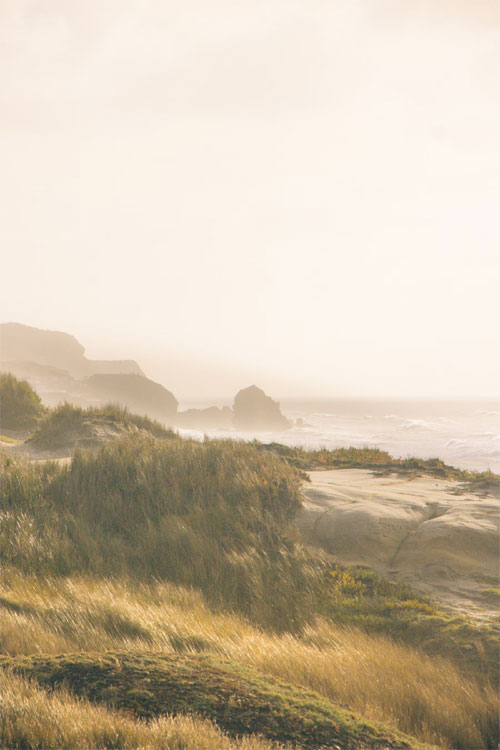
The air had that early‑spring sharpness that woke a man more thoroughly than any sermon. The sky was pale, the color of washed linen, and the sea beyond the village's roofs was a dull, pewter grey. He walked quickly, head down, boots sinking into the soft earth of the path that led toward the shore.
It was foolishness, he told himself. A habit with no meaning. A thing done out of memory rather than belief. But he went anyway. He always had.
His father used to say the sea remembered what men forgot. He had never known what that meant. Perhaps his father hadn’t either. Perhaps it was only something said to give shape to a custom older than either of them.
The path narrowed as it neared the water, the gorse bushes brushing against his cloak. The tide was low, leaving long streaks of weed and shingle exposed. He walked to the place where the rocks formed a small crescent, half‑sheltered from the wind. This was where his father stood. And his father before him. And now him.
He reached into his cloak and took out the offering: a small piece of oat bread, wrapped in cloth to keep it dry. He felt faintly ridiculous holding it. The priest would have called it superstition. Worse, he might have called it something darker. But the priest was not here.
He placed the bread on a flat stone at the water’s edge. The sea gave no sign, it noticed. A gull cried overhead, then fell silent.
He straightened, brushing the crumbs from his fingers. That was all. A moment’s pause in an otherwise ordinary day. A thing done because it had always been done.
He turned to leave.
Behind him, something moved in the water—just a ripple, nothing more, the kind of shift a man could blame on the tide or the wind or his own imagination. He did not look back. He told himself there was no reason to.
But as he walked away, the hair on the back of his neck rose, as if the sea itself were watching him go.
He had not gone far up the path when he heard it: a soft sound, like a hand brushing against wet stone. He stopped. The wind had dropped, leaving the morning strangely still. Only the faint hiss of the retreating tide broke the silence.
He turned.
A woman stood where the water met the shingle.
She had not been there a moment ago. He was certain of that. The beach had been empty when he placed the bread on the stone. Empty when he turned to leave. And yet she stood there now, as if she had stepped out of the sea itself.
Her cloak—if it was a cloak—hung heavy and dark around her shoulders; the fabric slick with water. Her hair clung to her face in wet strands, black as kelp. She was barefoot, though the stones were sharp enough to cut skin. She did not seem to notice.
For a moment, neither of them spoke.
He felt the instinctive jolt of alarm that any man might feel upon finding a stranger on a lonely shore at dawn. But there was something else beneath it—something quieter, older; a tug of recognition he could not explain.
She looked at him with an expression he could not read. Not fear. Not surprise. Something more like… assessment.
“You left this,” she said.
Her voice was low and steady. She lifted the piece of oat bread from the stone, holding it in both hands as though it were something fragile.
He swallowed. “It’s only a custom,” he said. “A family thing. I didn’t mean—”
“It is accepted,” she said, cutting gently across his words.
He blinked. “Accepted?”
She stepped closer. Not enough to threaten, but enough that he could see the droplets of seawater clinging to her lashes. Her eyes were dark, deep-set, reflecting the grey of the morning.
“You keep the rite,” she said. “Few do now.”
He felt heat rise in his face. “It’s nothing. A foolish habit. My father—”
“Your father kept it,” she said. “And his father before him. And now you.”
There was no accusation in her tone. No praise either. Only fact.
He found himself unable to look away from her. Something about her presence unsettled him—not in the way of danger, but in the way of a truth long forgotten and suddenly remembered.
“You should not be here,” he said, though he wasn’t sure why he said it. Perhaps because the priest’s warnings echoed in his mind. Perhaps because she looked like someone who belonged to no parish he knew.
“Nor should you,” she replied.
The words were not unkind. If anything, they held a faint trace of amusement, as though she found his concern oddly endearing.
A gull cried overhead, circling once before flying inland. The tide lapped softly at the stones.
He cleared his throat. “Are you… are you in need of help? You’re soaked through.”
“I am as I should be,” she said.
He had no answer to that.
She looked down at the bread in her hands, then back at him. “The offering is received. The warning is given.”
“Warning?” His voice sounded thin in the chilly air.
She nodded toward the headland. “The storm that comes tonight will be stronger than the others. Keep your boats ashore. Tell the fishermen.”
He stared at her. “How do you know that?”
She tilted her head slightly, as though considering how much to say. “The sea tells those who listen.”
He felt a shiver run through him—not of fear, but of something like awe.
She placed the bread back on the stone, as gently as if she were returning a borrowed thing.
“When the summer comes,” she said, “I will return.”
And before he could speak—before, he could ask her name, or who she was, or how she knew these things—she stepped back into the water.
Not wading. Not swimming.
Stepping.
As though the sea were a doorway, only she could pass through.
The water closed around her legs, her waist, her shoulders. She did not look back. Within moments, she was gone, the surface smoothing itself as if nothing had disturbed it.
He stood there long after the tide had erased her footprints.
He returned to the scriptorium before the priest finished his sermon draft. The man was still pacing behind the half‑open door, muttering phrases under his breath, testing cadences. The clerk slipped back to his desk, lifted the quill, and forced his hand to steady itself over the ledger.
But the ink trembled on the page.
He wiped it away quickly, hoping the priest hadn’t noticed. His heart was still beating too fast. The woman’s voice — low, steady, certain — echoed in his mind.
The offer has been received. The warning is given.
He tried to focus on the numbers. Grain tallies. Fish quotas. Names of men who owed the parish a tithe of barley. All the ordinary things that made up his days. But the memory of her stepping into the water — not wading, not swimming, but stepping — kept rising like a tide he could not push back.
He had just finished rewriting the smudged line when the priest’s door creaked open.
“Out early this morning,” the priest said.
The clerk’s hand froze. “Father?”
The priest stepped into the room, smoothing the front of his robe. He was a tall man, narrow‑faced, with eyes that missed little. “I saw your cloak gone from its peg. Thought perhaps you’d taken ill.”
“I’m well enough,” the clerk said. “Just needed some air.”
The priest nodded slowly, as though weighing the truth of that. “The mornings are still cold. Best not to wander far.”
“I didn’t,” the clerk said too quickly.
The priest’s gaze sharpened. “The shore path is treacherous after rain.”
A small, cold knot formed in the clerk’s stomach. “I wasn’t—”
“Some of the villagers,” the priest said, cutting him off gently, “have spoken of strange shapes in the water. Lights. Voices. Old tales resurfacing.” He gave a thin smile. “Superstitions cling hardest in places like this.”
The clerk forced himself to meet the priest’s eyes. “I saw nothing of the sort.”
“Good,” the priest said. “A man of letters should keep his mind clear of such nonsense.”
He turned as if to leave, then paused. “If you do hear anything unusual, you’ll tell me.”
It was not a question.
The clerk nodded. “Of course, Father.”
The priest lingered a moment longer, his gaze drifting to the clerk’s damp boots, the faint trace of sand clinging to the hem of his cloak. Then he gave a curt nod and returned to his room, closing the door with a soft click.
The clerk let out a slow breath.
He had not lied — not exactly. He had seen nothing that could be easily named. Nothing he could explain. Nothing he could confess without sounding mad.
But the priest’s words unsettled him. Villagers speak of shapes in the water. Had someone seen her? Had someone seen him?
He dipped the quill again, but his hand still shook.
Outside, the wind shifted, carrying with it the faint scent of the sea. He closed his eyes for a moment, feeling the memory of her presence settle over him like a shadow. When he opened them again, the ink had pooled into a dark blot on the page.
To Be Continued...