
His half of our cabin is filled with all the crap he needs for his act. There’s a feather boa, bright pink, draped over the bed head, juggling balls on his bedside cupboard, glitter-littered tinsel-covered manifestations of artificial merriment, which long for an audience and do their best to create a notion of artifice. I could punch him in the throat. And not only that, but he’s put up these multicoloured lights.
‘If the ship sinks, you won't have time to round all that up’, I told him one night, as he was taking off his makeup.
‘Cheap tat’, he replied. He leant forward to gaze deeper at himself in the mirror. ‘Just like my act, really’.
‘Did you have a good audience today?’
‘Sluggish. Definitely sluggish. I think they’d all just had a big meal’.
‘There was a bit of a swell, too’.
‘I didn’t drop anything’. He leant back in his chair and stretched his arms wide. ‘I’m going to take a shower’.
He got up and flung his sequin jacket onto his crowded bed. Shards of light reflected from the low plasterboard ceiling. I went back to my book.
The carpets in each cabin were all the same shade of light brown. It was the only splash of colour. Not like the relative opulence of the passenger cabins, of course. Around his area of the room there was a sprinkling of glitter whose iridescence became more pronounced as the ship swung slightly, twinkling and blinking with the motions of the vessel, and a more poetic soul might even have seen in their twinkling a myriad of impossible and imaginary constellations. No doubt he would sleep-in tomorrow, until I’d wake him by vacuum cleaning those imagined galaxies.
There was no window in the room. There were curtains drawn across a patch of blank wall in an approximation of the home comforts and of keeping the night at bay. He’d not known this when he was first assigned to this cabin, he’d flung the curtains open and stood in the middle of the room looking at the plain white wall.
‘Foggy out there, isn’t it?’, he’d said, realising his error.
And then he’d drawn the curtains again and mentioned it no more.
One day he had been sure that I’d brought one of the bees back with me, and I’d asserted that this was not the case, but he said that he could hear a constant buzzing and that it must have been attracted by his colourful outfits, his spangly costumes with their garish colours. In truth, due to the very nature of my job, I had become somewhat deaf to the constant buzzing, but I felt obliged to assure him that there was no such bee, and indeed that in all of my years working with them, I had not once been stung.
‘Perhaps it was on your clothing?’
‘I wear a protective suit at all times’.
‘Even so, you might not have realised’.
‘There is no bee’.
‘Are you sure?’
‘It’s probably just the vibrations of the engine, the propeller, being projected through a panel or a loose fitting somewhere in here. It happens all the time’.
‘I won't be able to relax’.
‘There is no bee’.
The moment he was satisfied that I was telling the truth, and had become distracted by his mobile phone, I saw the buzzing bastard crawling on the arm of his sequinned jacket.
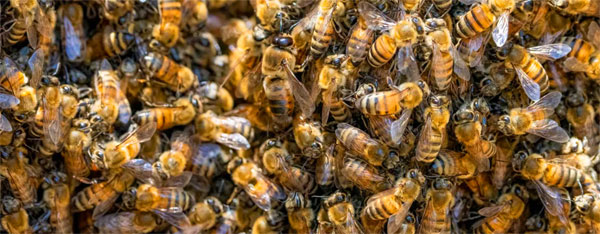
The beehive was located just behind the forward funnel on top of the ship. A fierce sun accentuated the white walls and painted red floors of the main vessel superstructure, glimmered from polished rails and glass windows as if intent on highlighting the vividness of the various colours, functional pipes, nautical accoutrements, which in turn seemed to exist in honour of human achievements, this conquering of the seas. I was in my protected overalls and hood, and the white walls of the ship allowed me to see the bees as they flew in and out of the hive carrying their pollen from the various plants and flowerbeds dotted around the restaurants, terraces, swimming pools and main atrium of the liner. I could feel the deck shuddering beneath my feet, the breeze as the ship continued its inexorable voyage, though there was hardly a swell.
I went about my work for a while, checking on the welfare of the bees, entranced as ever by their industry, their nonchalant manner, the wax hives rich with honey and the inner workings of their community. It seemed as ever the very definition of harmonious living, where everyone has a job and feels compelled just to get on with it. There was something comfortable about it and as I worked I reasoned why a soul would ever be drawn away from the comforts of work and the overall benefit of their community. There are systems and rhythms in nature much like the rhythms of the sea, and much as we may pertain to individuality, the truth is that those around us make the necessary adjustments thereby blunting whatever effect we might have been aiming for. There are no rebel bees. There is no tinsel.
I glanced to the left and right. Occasionally, a passenger will spot me and, interested, enquire as to my profession, but I’d not been spotted today. Strictly speaking, I was in an area where passengers were not permitted, but the company aims to make every passenger feel welcome and I have been briefed on good customer service practises. There was nobody around. I lifted off my hood and spoke to the bees.
‘Come on. You can do it’.
There was no noticeable change in the attitude of the bees, though one or two, it must be admitted, flew closer towards my face than would usually have been likely. I closed my eyes and pretended to feel the tickle of their legs on my chin, but no such feeling came, and after a while I had to admit to myself that the bees were somewhat withdrawn. I gave it a few more seconds, and the admitted defeat.
‘I say!’, someone called, his voice carried by the breeze, ‘Could you direct me to the on-board bowling alley?’
‘We’re miles from land’, I replied, replacing the hood. ‘Everything is on-board. You don’t need to say on-board, it’s obvious that the bowling alley will be on-board’.
‘Well, where is it?’
‘Entertainment deck three, front section’.
‘Cheers’.
That afternoon a swell developed which gave the world a pronounced bounce. You get used to walking after a while, the timing of each step, but you never get used to the thought of the ocean deep, the vast cold darkness under your feet. Satisfied with bee welfare, I had lunch in the staff canteen with its plain white walls and its Formica tables bolted to the Lino floor, easy-wipe skirting boards, functional lighting so very unlike the veneer of luxury in the passenger spaces. Isn’t everything, I told myself, a veneer of sorts? Nobody sat with me. I had yoghurt, and I poured honey on the yoghurt, and a cup of coffee which I sweetened with honey, and my spoon rolled around the table top of its own accord.
I had been asked to give a speech in the library the next afternoon on the intricacies of beekeeping and, as I ate my yoghurt, I pondered on the form this speech would take and what questions the passengers might be compelled to ask. I had even prepared a couple of jokes. I hear tickets for this event were fairly cheap. That’s great, because I wouldn’t want any of you to be stung. That’s the one that I thought I would open with, followed by, I always get such a buzz delivering talks like this. I may not have been a stand-up comedian, but I knew that these original and fresh Oscar Wilean one-liners would probably elicit a favourable audience response and thereby aid comprehension of the subject at hand.
A young lady came and sat at the table next to mine. She was obviously one of the many on the vessel employed as a cleaner judging by her subdued polo shirt and lanyard. She looked tired. She poured cereal from a box into a bowl and added milk, then began to eat contemplatively, staring into space. The cereal box was decorated with a giant cartoon bee with its big blue eyes and grinning expression, it held a giant metal spoon in its hand.
‘Just thought I’d point out’, I say to her, ‘That bees don’t actually have hands’.
‘What?’
‘Bees don’t have hands’.
‘What do you mean?’
‘The cereal box. The bee is holding a spoon. Bees don’t actually have hands’.
‘So?’
‘Just thought I’d point it out’.
‘It’s been a long day’, she sighed. ‘I’ve been on duty for ten hours. I don’t care about cartoon bees’.
‘Not many people do’.
She smiled.
‘If this is your best attempt at a chat-up line, then I must say, it needs a bit of work. I’m afraid’.
‘Really?’
‘It’s the worst I’ve ever heard’.
‘Are they usually bad?’
‘Terrible’.
‘No, I’m just a regular chap with a fascination with bees, and when I see them misrepresented in the media, then I become somewhat passionate’.
She laughed.
‘You’re really quite eccentric’.
‘Maybe’, I replied.
‘And that’s a good thing’.
Not if you’re a bee, I felt like replying, but I remained quiet.
She turned her attention back to her cereal. She had one hand placed around the base of the bowl as the ship went through its motions. I doubted whether there was very much actual honey content in the cereal she was eating, but I decided that next time I was in the staff canteen I would at least give it a go. And perhaps I might even send an email to the cereal manufacturer, pointing out one or two anatomical inconsistencies.
The main atrium of the ship reminded me of a shopping mall, with its gleaming floors and convoluted architecture, glass ceiling, polished rails and shops. In the middle of this imagined space of corporate opulence was a mini-rain forest in whose luscious and flowery depths the bees got to work, an added touch which the passengers no doubt completely ignored, a final layer of authenticity in this unlikely scenario. I passed through the passengers with a sense of purpose. Perhaps I was the only one there with a sense of purpose. The rocking motions of the ship did not help matters, people were lurching from side to side and slowed my progress, for I really wanted to go back to my cabin -- our cabin -- and work on my presentation for the following day.
My route took me past the doors to the theatre. The swaying motion of the vessel was the only indication at this point that we were on an ocean-going craft. The corridor leading to the theatre was deeply carpeted, plush, and each step cushioned. I showed my identification lanyard to the lady on the door and she waved me through into the dark auditorium where a show was progressing on stage.
I sat in a seat at the back of the auditorium.
He was spinning plates. My cabin-mate, in his spangly sequined jumpsuit and jacket, glittery top hat and make-up, ran from one pole to the next where plates were spinning, trying to keep the momentum going. Naturally, the motions of the ship did nothing to help him in this chore and the look of worry on his face seemed genuine. It was the same look he had on his face that time he thought he had seen a bee.
The audience were not exactly engaged. Indeed, they were not exactly an audience, merely around ten, fifteen people dotted around the two hundred seat space, watching disinterestedly as he ran from one pole to the next. The music did not help matters. The music was more the sort of music you might hear during a chase sequence in a comedy film, not that I am particularly a fan of that genre. The ship creaked and heaved and the poles supporting the spinning plates all swayed with it, then swayed the other way, but by some sort of magic force, or perhaps, scientific momentum, centrifugal mathematics, or just plain cheating, the plates stayed spinning at the tops of each pole. Yet still he ran from one to the other, one to the other, keeping them spinning, the music playing, the ship swaying. A vicious series of swells, however, caught him off guard, and he came crashing to the floor, he slipped and landed kind of spread eagle between two poles, knocking their bases and causing the plates to tumble from them, and then there was another swell and the other plates all came crashing down around him too, shattering into shards of broken ceramic on the floor of the stage as the audience laughed, and hooted, and laughed, and laughed again.
He got to his feet clutching his arm and they clapped. And I clapped, too. I had a big smile on my face.
‘I’ve been stung!’, he yelled. ‘Something has stung me! My arm! I need a first aider!’
The curtains swished closed and the audience clapped again. A disembodied voice from one of the speakers thanked them all for coming, and they made their way up the aisles, slowly, sluggishly, holding the armrest of the seats to steady themselves.
I was still laughing.
‘It’s coming up in a swell’, he said, looking at his arm.
He was sitting on the edge of his bed in just his gold sequinned boxer briefs. As if even this humdrum pseudo-domestic scene could not be played out with anything other than a modicum of artifice. The bump on his upper arm was pronounced and very clearly a sting of some kind, though to blame it on a bee was somewhat jumping into the territory of the obvious.
‘It might have been a wasp’.
‘Where would it have come from? We’re in the middle of the ocean’.
‘I despise wasps’, I told him.
He kept poking at the sore area with his forefinger.
‘The first aid officer told me that she has had a lot of stings lately among the passengers and crew. She made me fill out a form’.
‘And what did you write in the form?’
‘That I had been stung by a bee’.
‘You had no right to use that term!’
‘What am I, anti-bee? Is that bee-ist terminology? What else could it have been, eh?’
‘Spiders bite. Or it may have been a stinging nettle’.
‘On a theatre stage on a cruise ship?’
‘You’re right, that is somewhat far fetched. Maybe it was a jellyfish’.
‘I don’t care what it was, it hurts.’
He jumped off his bed and went into the bathroom. I felt an anger growing inside of me, for I could see that there might very well be ramifications from this apparent latest bee-inflicted injury which might mitigate against my continued employment on the ship as beekeeper. I looked down at the light brown carpet and felt a sense of calm come over me. The carpet was so no-nonsense. Would a company which fitted out its staff cabins with such a no-nonsense carpet fall for the deranged bleatings of a sequin-wearing circus plate spinner over the calm assurance of a humble nautical beekeeper?
‘I think they’re going to have a word with you tomorrow’, he yelled from the bathroom.
‘What do you mean?’
‘The first aider. She tells me that she’s been speaking with Human Resources and even the captain about the fact that so many of the passengers are getting stung. They want to do something about it’.
‘And do you believe them?’
‘The first aider? Sure. Why would they lie?’
‘Maybe they just don’t like bees’.
‘She didn’t mention hating bees’.
‘The anti-bee brigade move in surreptitious ways’.
If you looked closely enough you could see the individual fronds of the functional carpet and the way that it fitted so neatly and so closely with the cabin skirting board. If you didn’t know any better, you’d think you were in an actual building, though everything was lightweight and prefabricated, and that continual motion of the vessel which hinted at perpetual movement. Surely, I reasoned, a company which put so much effort into denying its staff the artifice presented to its passengers would never deny the existence of bees in full knowledge of their work in propagating the very plants which added to that artifice?
‘It’s swelling even more’, he said, from the bathroom. ‘It’s ballooning up. What if I’m having some sort of reaction to it?’
I ran my hands along the smooth surface of the wall. There wasn’t much give in the wall. It was a sturdy design which would probably have worked in a real building, with rooms and floors, static, motionless. I pressed as hard as I could and the wall hardly moved at all.
‘I’m giving a talk this afternoon in the library about beekeeping’, I said to the young man after he’d asked directions to the on-board shooting range, the next morning.
‘You are?’
‘Indeed’.
‘Swell’.
And we both just kind of stood there for a little while.
‘So . . . The on-board shooting range?’
‘Entertainment zone three’.
‘Thanks’.
‘This afternoon. Beekeeping. Remember that’.
‘Right’.
And off he wandered.
I let myself out on deck and began climbing the restricted access stairways to the area around the forward funnel. The sun was beating down and it felt like it was going to be a hot day. I’d spent the night thinking about what my roommate had been saying, about the bees stinging people, and passenger and crew reporting stings and seeking medical advice, but it seemed obvious, the more I thought about it, that these people were just ignorant in the ways of bees and were attaching unnecessary blame to the on-board beehive. Indeed, the stinging might very well have been a psychosomatic symptom of mid-voyage malaise, the body’s method of saying, hey, you need to experience something else for a bit.
‘On-board’, I’d whispered. ‘Of course it’s on-board, you blasted fool’.
And if this were the case, then the company was big enough and functional enough to realise that the blame was obviously not with the bees.
But I was feeling optimistic and the summer sun definitely added to this, making me realise that anything is possible, that all barriers might one day be overcome, all targets met.
I zipped up the overalls and placed the hood over my head, subdued the bees and went about my daily chores. The bees seemed fine. Indeed, they had been most industrious since my last visit, or so it appeared, and I watched them for a while as they quivered and danced, buzzed and flapped and crawled and went about their communal business.
My room-mate could not possibly have been stung by a bee, of course. The fact that he seemed more than usually wary of the existence of bees and somewhat paranoid about their possible ingress into our shared cabin made it even less likely that he should fall victim to the random sting of a honey bee while going about his plate-spinning demonstration. The world, I reminded myself, does not move in such clear-cut ways. Inhabitants both of a cabin whose functional design and light brown carpeting mitigated against the obvious, we were therefore seemingly immune to the irony that would have been evident in his actually getting stung.
I looked to my left and to my right. There were no passengers within sight. I removed the hood from my head and said to the bees, ‘Come on, then. Come on, my lovelies. You know you can do it. You know you want to do it’.
I closed my eyes and stood there, feeling the sun on my face and the motions of the vessel, the engine throbbing beneath the deck, the smell of exhaust from the forward funnel. And then I felt it, too. The tickling sensation of their tiny legs on my chin, crawling, moving around. I tried not to smile, for doing so might have made them cautious and no doubt they would have flown away, but they were definitely there. Slowly, I opened my eyes and looked in the mirrored glass of a nearby window. I had a goatee. A bee goatee. Maybe there were fifty of them, at the most. Fifty bees, accumulated, happy, nonchalant, not exactly a swarm but enough to make the average person look twice. I had a bee goatee. My face, and below my mouth, on my chin, a bee goatee. I couldn’t help smiling, but they stayed there, and at that moment I realised that we were all working in perfect harmony, that perhaps I had been admitted to the hive or at least acknowledged as one of those components which makes the hive function. The smile became broader and still the bees did not move, we were interacting like one of the finest ecosystems, the bees and myself, a mass of biodiversity for the soul.
‘And so it begins’, I whispered to the bees. ‘So it begins’.
And still they stayed there. I walked around, me and my bee goatee, but they weren’t put off at all, and indeed, we might very well have stayed like that for as long as they saw fit had not the captain chosen that moment to issue a long, pronounced and very loud blast from the ship’s horn. At once, the bees took to the air and returned back to their hive and their regular chores.
‘Today’, I told myself, ‘Is going to be a very good day’.
There were maybe as many as twenty books in the library. Twenty actual books, with pages and spines and covers and all of the usual attributes of a book. The rest of the library was taken up with fake wood fittings, chipboard veneer shelves, plush carpeting, polished surfaces, a globe, reading lamps, comfortable chairs, and three walls of moulded glass fibre which looked from a distance like shelves and shelves of books but was actually cleverly-designed and incredibly artificial with fake book titles and even pretend dust. It was here that the Human Resources manager explained the thinking behind the company’s decision to do away with the on-board- beehive.
‘So you understand, it presents a very real health and safety issue. We do have to put the welfare of our passengers -- and even our staff -- first. But there has been a recent upsurge in bee stings and just a quick glance at our accident reporting system will red-flag an issue. And issues, need I tell you, must never be red-flagged. Something had to be done, and the decision was taken’.
‘There has been a mistake . . ‘.
‘There certainly has. The previous chef was a temperamental soul who insisted on fresh honey, that’s why the beehive was installed. But he’s gone, now. The beehive is an extravagant luxury which, only now do we realise, we just cannot afford’.
‘Someone has put you up to this’, I told her. ‘It was an acrobat, wasn’t it? One of the circus acrobats that you insist on entertaining the passengers with. He’s had it against the bees since day one . . .’
‘Any issue which the system red-flags has to be investigated’.
‘He spins plates. That’s all his act consists of. He puts plates on poles and then he runs around and spins them. Anyone could do that. And he wears the most ridiculous costumes . . ‘.
‘There was no specific one complaint’.
‘But there have been complaints?’
She sighed.
‘Plenty. Families relaxing by the pool with an ice cream. Couples enjoying a meal in the restaurant. Even the Captain. They’ve all been stung, there are over a hundred reports . .’.
‘The Captain?’
‘She was going for a moonlit stroll along the deck when a bee swung down out of nowhere and stung her. It was reported as if it had happened to anyone else. I’m afraid the beehive will have to go. It is a health and safety risk’.
‘I see’.
She looked at me for a while from over her clipboard.
‘Procedures will be put in place to drop you off at the next port. If you could begin the process of dismantling the hive as of tomorrow morning, we would all be very grateful. And thank you so much for your service on this vessel’.
I looked at her for a while.
‘What are you doing now?’, she asked.
‘I’m meant to be giving a speech to interested passengers on the intricacies of beekeeping. I’m assuming . . I’m assuming that this may still go ahead?’
‘Of course’, she said. ‘Have a good speech’.
She turned on her heel and left.
I didn’t know what to think, of course. First, the facade of this evidently fake library hinted that the company really did make every effort to gloss over the truth in any situation. And now the idea that the Health and Safety System -- whatever that was -- had decided that the vessel would function pretty well without me, demonstrated that there was something amiss at the heart of this whole endeavour. How could we all possibly work as a team, as a society, if there were certain elements which were decreed to be beyond maintenance?
He would be in our cabin right now, probably. Preparing himself for his afternoon’s plate spinning session, with bored passengers watching from the dark of the theatre. He would be putting on his make-up and his sequinned jacket and he would be going over his routine again in his mind, reminding himself of how it went. It was simple, really. All he had to do was spin plates balanced on poles. He would be sitting there, in that functional cabin, adding another layer of artifice to the world.
I tried not to think about it. I went to the ornate chipboard veneer doors of the library and opened them wide to admit those who were waiting to hear my speech on the intricacies of beekeeping. But the moment I opened the doors, I realised that there was something amiss. Nobody was waiting.
I stepped out into the corridor and looked up and down. I could see the shops and the boutiques, the massage parlours, the beauticians, and there were passengers wandering around, relaxed, ignoring the slight swell that had built up over the last hour or so. But it didn’t look like any of them were heading towards the library. I leaned my hand on the doorpost and I breathed out a big, long sigh.
‘Typical’, I whispered.
What else could I have done? If I’d have gone up and removed myself from the library, then someone might have turned up expecting to know all about beekeeping and I would not have been there. Did I not still have a duty to spread the joy and interest in beekeeping? Maybe there had been a simple mistake, and the wrong time had been advertised? Maybe I should have done more to get word out that this was going ahead, rather than just rely on world of mouth? I decided that I would go ahead with the speech.
I stood at the far end of the ‘library’. The floor was raised here by a step where other people had stood in the past and delivered speeches on matters of interest to the passengers, such as the flora of paradise islands, or the methods of writing the perfect haiku. Surely I would not be the first person ever to have an audience of zero? I gathered my papers together and looked down at them, and noticed that my hands were shaking somewhat. Probably the swell, I told myself. Probably the vibrations coming from the ship’s engine and the propellers. I cleared my throat, and I was just about to begin, when I heard a buzzing.
As I may have relayed earlier, I do not often hear the buzzing because my work with beehives has conditioned me to this sound for many years. But it was unmistakable, and it was coming from the corridor, from the atrium at the end of the corridor where I now could also hear gasps, and screaming, and the stamping of feet. Strange, I thought. Perhaps this is some kind of activity organised by the on-board entertainment crew, some minor distraction for the more agile among the passengers. I turned my attention back to my shaking hands and was about to voice the first line of my speech, when the bees started coming in.
Thousands of them, a cloud of bees, buzzing, a murmuration of bees in a formless ever-changing shape which drifted in through the fake ornate doors like the visual manifestation of a migraine and then around the periphery of the fake ornate library, and then towards me, thousands and thousands of them, and before I knew it, they had started accumulating on my chin.
There was no real weight to them. They seemed to support each other, intent on some kind of communal impulse, perfectly happy just to sit and crawl and buzz and dance until the lower part of my face was covered. This was more than a mere bee goatee like earlier in the day, this was a full-on beard as if I had taken years to cultivate it, and beneath these black and yellow furry beasts a big smile broke out on my face.
I took two steps and they stayed where they were. I took two more, and stepped off the raised end of the ‘library’. They moved and shifted, certainly, but the bee-beard maintained its structural integrity with surprising ease. I stepped through the ‘library’, past the fake leather armchairs and the polished coffee tables, past the globe and the brass reading lamps, to the door, and then out into the wide corridor, where people were still running around, screaming, their hands flailing in the air.
Someone saw me and she pointed and let out a scream. Someone else saw me and he fainted, collapsing slowly to the plush carpeting like a tree being felled. Yet I did not mind, for I realised that this was my hour of destiny. Slowly, assuredly, I walked away from the ‘library’ to the atrium, the sunlight streaming in through the glass ceiling and illuminating everything with a sudden vibrancy, from the exotic plants and trees to the water in the fountains to the black and yellow furry bodies of my new-found friends.
For some reason I knew where I was going. I climbed up an ornate staircase to the next level and then along the mezzanine to the corridor where I would find the theatre. People were still screaming. The moment they saw me, they screamed and dived out of the way. I got to the door of the theatre and fumbled around underneath the beard of bees for my lanyard, showing it to the young lady on the door who, in any case, had gone off screaming into the dark depths of the cinema. And there he was on stage, my roommate, beginning his plate-spinning routine to the amusement of the modest crowd that had gathered to watch.
I walked down the steps of the auditorium to the stage. Of course, he couldn't see me coming because of the bright lights, and the swell was causing the ship to rock ever so gently like a child in a cradle, so he was concentrating on his plate-spinning. Perhaps that’s why he didn’t even see me climb on stage with my beard of bees, until it was too late. I walked right to the middle of the stage, right past him and watched as he kind of fell over backwards and backed away on all fours like a crab, a lock of sheer horror on his face. People in the audience didn’t really know what to think. Some of them were screaming, others assumed that it was part of the show, but I stood there, right in the middle of the stage, and I opened my arms wide to accept their acclaim as one by one all of his plates came crashing down.