
Solar Spectres
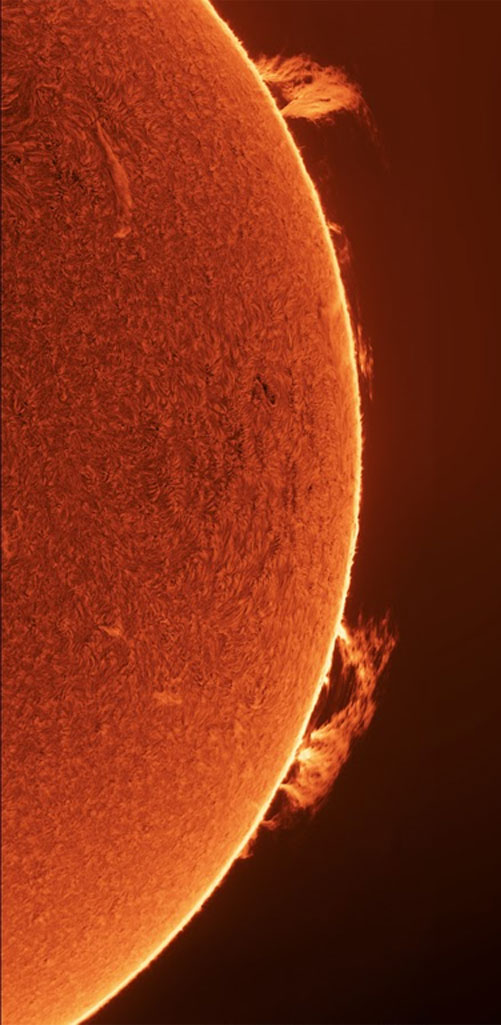
Here be dragons, hiding in broad daylight,
basking in the photosphere's blinding glow,
only visible to the unaided eye
when sunlight fails mid-day
and birds roost in untimely darkness.
That is how I first saw them,
rearing their huge heads
around the Moon's silhouette.
I see them more often now,
as I gaze into the deepest
of spectral lines, their lairs.
There I can find them,
their translucent forms dancing
along magnetic field lines,
bright Ellerman bombs
flaring up around them.
Other days I see them leaping
in vast arcs beyond the sun's limb
or erupting in loops and plumes
of incandescent plasma.
Some break loose,
escape the clutches of gravity,
burst through the corona
and speed off into space.
In that emptiness
some are drawn towards Earth.
Guided by magnetic fields,
they congregate at the poles
and give birth to lesser dragons.
Far smaller, far colder
than their mighty forebears,
but just as colourful.
I have yet to see their ghostly forms
dancing around Polaris
on Arctic nights.
The "Here Be Dragons" image shows part of the sun in Hydrogen-alpha light (656.28 nm) taken through an extremely narrow-band filter (0.3 Å, or 0.03 nm wide), which reveals the outer chromosphere of the sun, with prominences. sunspots, and flares. 3-pane mosaic taken with an APM 80 mm F/6 triplet apochromatic telescope, Baader TZ-4 telecentric 4x lens, for a total focal length of 1920 mm, using a ZWOptical ASI174MM planetary camera.