
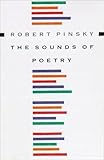
The Sounds of Poetry: A Brief Guide by Robert Pinsky is not merely a handbook about verse — it is a portal. It is a manifesto, a classroom without walls, and a companion on the remarkable journey from mere reading to deep listening. In an age where poetry often feels distant, opaque, or reserved for academia, Pinsky’s work stands out as revolutionary and transformative, an invitation to reevaluate what poetry feels like as much as what it means.
First published in 1998 and consistently in print ever since, The Sounds of Poetry has become a touchstone for writers, teachers, students, and lovers of language. Rather than arguing that poetry is difficult, Pinsky shows us that poetry is vivid, accessible, sonorous, and alive, once one understands how to listen. This book doesn’t dissect poems into lifeless fragments; it teaches readers to hear the vibrations beneath the words, the rhythms that make language breathe, and the cadences that make verse feel like music.
It is a rare work that feels both poetic and practical, intellectual and immediate, a treatise on craft that actually changes the way you read poetry.
__________________
Why This Book Is So Revolutionary
What makes The Sounds of Poetry revolutionary is not its content alone, but its method of transmission.
While most introductions to poetry focus on thematic interpretation, historical movements, or literary theory, Pinsky’s guide pivots to the sensory experience of sound. He posits, with eloquent clarity, that understanding the soundscapes of poetry, the very way it resonates in the human ear, is central to genuinely experiencing it.
Pinsky writes:
“Poetry is what language does that prose does not.”
This simple, brilliant premise reframes poetry from being an abstract object of study to a living, resonant event. In doing so, Pinsky democratizes poetry, he makes it hearable rather than hierarchical. He invites readers to reconsider all familiar assumptions about verse and replace them with an ear for sound, rhythm, accent, pace, and breath.
To quote from his text:
“Sound is the language of the body. Meaning, the mind.”
Pinsky shows that when sound is honored as the foundation of poetic experience, meaning naturally emerges rather than being forced.
__________________
What the Book Teaches — and Why It Matters
The Sounds of Poetry is both a guide and a series of epiphanies. Organized into short, deeply thoughtful chapters — such as “Accent,” “Rhyme,” “Tone,” “Pace,” and “Breath” — Pinsky walks the reader through the mechanics of sound not with dry theory but with palpable, aural delight. He engages examples from Shakespeare to Lorca, Dickinson to Whitman, Neruda to Rilke — and he analyzes them not just intellectually but aurally, teaching readers how to hear poetry with heightened awareness.
For example, Pinsky’s discussion of accent reveals how stress patterns in English (and other tongues) create emotional momentum. His exploration of breath shows that silence, the space between sounds, is as expressive as the words themselves. What other poetry guides treat as arcane or intimidating, Pinsky frames as embodied experience. This approach makes the book invaluable not just for writers and scholars, but for anyone who loves language.
Research in cognitive psychology supports this emphasis on sound as central to linguistic meaning. Studies have shown that rhythm and prosody are processed in regions of the brain linked to emotion and memory, the same neural circuits that help us recognize musical patterns. This scientific grounding aligns beautifully with Pinsky’s thesis: poetry works not only on the page but in the human body and nervous system. Sounds activate emotional memory; rhythm attends to focus; cadence engages breath, all of which are vital to the poetic experience.
When viewed through this lens, The Sounds of Poetry moves beyond literary instruction into the realm of human perception and empathy.
__________________
How Pinsky Teaches You to Hear Poetry
One of the most compelling things about this book is its ability to shift perception. After reading it, even a casual reader will notice the vibration in simple lines of verse. A phrase like “Do not go gentle into that good night” becomes not just a textual meaning but an aural experience, and this experience transforms interpretation. Pinsky’s own enthusiasm for sound becomes contagious; readers find themselves listening before they read.
Examples in the book serve not as illustrations but as invitations. Each poem becomes a sound experiment, a place to test one’s ears and attention. Pinsky encourages the reader to read aloud, to feel the shapes of language in the body, to notice pauses, accelerations, and tonal shifts. For many, this practice opens doors not just to understanding poetry better, but to reclaiming language as a physical, tangible, emotional force.
Scripture says that “the body is a temple.” Pinsky suggests that our ears are its sanctuaries, and if we listen deeply, poetry reveals itself as an art form that resonates within the bloodstream.
__________________
Historical and Cultural Context — Why the Book Endures
Robert Pinsky served as U.S. Poet Laureate from 1997 to 2000, during which time he championed public engagement with poetry and listening as a fundamental skill. His tenure marked a period when poetry was being reimagined as a popular, not pedantic, form of cultural expression. The Sounds of Poetry was a key part of this effort, reframing poetry as an experience rather than an academic puzzle.
In the decades since its publication, the book has remained in print, been widely used in writing courses, and been embraced by teachers across disciplines. It occupies a rare space in literary pedagogy, one that honors tradition without being trapped by it. Comparatively few poetic guides have achieved such longevity; many books on poetry fade as theory evolves, but Pinsky’s work endures because it teaches how to listen, not how to interpret.
Research into poetry education supports this approach. Surveys of poetry engagement show that students and readers who are taught through immersion in sound, performance, and reading aloud demonstrate stronger emotional connection to poetry and increased long-term engagement compared to those taught through purely analytical methods. This suggests that Pinsky’s focus on sound isn’t only aesthetically valuable, it is pedagogically effective as well.
__________________
Pinsky’s Prose — Intellectual Yet Accessible
One of the book’s greatest strengths is Pinsky’s voice. This is a scholar who writes like a poet speaks, with warmth, clarity, and curiosity. He never assumes that his reader already knows what a “metrical foot” is; instead, he invites the reader to experience it. His tone is encouraging rather than prescriptive, conversational yet rigorous. This combination makes the book uniquely accessible to a wide audience, from seasoned poets to casual lovers of literature.
Unlike many academic texts that demand expertise upfront, The Sounds of Poetry gives readers permission to be beginners. Once the door to listening is opened, Pinsky guides step by step deeper into the rhythms, resonances, and cadences that make poetry alive.
__________________
Who Should Read This — And Why
This is a book for writers, educators, performers, students, and anyone who has ever felt that poetry was “difficult” or “inaccessible.” But it is also a book for readers of all kinds, because it reintroduces us to something fundamental: language is not a flat series of words on a page, but a lived, sounding phenomenon.
If you have ever been moved by music, you will appreciate this book. If you have ever been captivated by the sound of someone’s voice, you will understand the power of Pinsky’s argument. If you have ever wondered why poetry feels different when read aloud, this book offers the answer, and then takes you further.
__________________
A Book That Changes the Way You Hear the World
The Sounds of Poetry: A Brief Guide is not just a guidebook; it is a revolution in listening. It teaches that the beauty of poetry emerges not only from what is said but how it sounds in motion, rhythm, breath, and voice. Reading this book changes you, not merely intellectually, but sensually. You begin to hear poetry everywhere: in the cadence of everyday speech, in the rhythms of music, in the whisper and crash of wind on the open page of the world.
This is a gift — not just to poets, but to all lovers of language.
__________________
Explore the Beauty of This Book
To truly understand The Sounds of Poetry, you must approach it not as a textbook but as a conversation between your ears and your imagination. Read it slowly, read it aloud, and let it transform the way you listen to language. Pair it with poetry readings, live performances, or recordings of poets reading their own verse. Let every line teach you not just what poetry means, but how it feels in the body, in the breath, and in the pulse of sound.
This is not just a book to read — it is a book to experience.
Explore it. Let it change the way you hear the world.
Share it with others, because listening together makes poetry come alive.
Return to it again and again, for a book like this never truly ends; it continues in every poem you hear thereafter.