
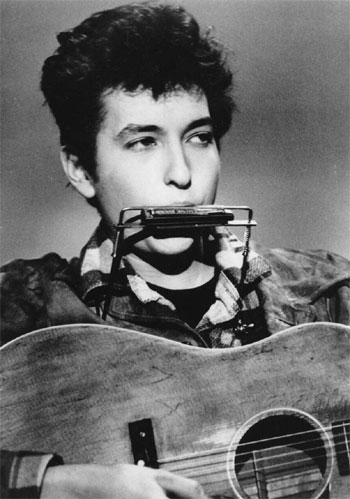
“He’s kind of a musical primitive,” said Kim. “His guitar playing is limited.”
“And half the time his lyrics don’t make any sense,” I said. “I just don’t understand why he got the Nobel Prize. Joni Mitchell and Paul Simon are better song writers.”
“And his voice isn’t even always in tune.” I was glad that Kim agreed with me since she is a talented flutist who actually has some knowledge of music. As with so many things, when it comes to discussing music I just fake it.
“Our friend Cecelia was a huge Dylan fan,” said my wife. “Her office was covered with pictures of him, quotes from him. She even loved his Sinatra album.”
“His covering Sinatra was a desecration,” I said. “Of course, I haven’t heard the album, but it can’t be good.”
We were driving back from the Staunton Music Festival, where highly trained, amazingly skilled musicians had played the great Europeans of the past centuries, alongside various experimental compositions by more contemporary composers. Yet somehow, Bob Dylan kept coming up.
One of those weird silences that often occur crept up on us. Kim had just come back from Finland and was suffering jet lag and we had to keep talking so that she would stay awake. My wife and I can’t drive, which might be a lucky thing for the safety of our nation’s roads, so our fate was in Kim’s hands as she navigated the zags and intricacies of our highway system while high-speed trucks swooped by. Kim was the captain of our ship, the keeper of our souls.
“Of course, he was a huge cultural influence” I said loudly. “If they had to give the Nobel prize to a folkie, maybe it should have been Dylan.”
My wife, too, claimed to dislike Bob Dylan, although she was obsessed by him. When “He’s Not There,” that avant-garde film about Dylan’s chameleon nature, had arrived in theaters, she had insisted we go. About a decade later, when the more conventional “A Complete Unknown” came out, she had insisted we stream it. A few days after that, infected by the movie soundtrack playing in my mind, I found some Dylan on Spotify, but his singing annoyed my wife. “Turn that off,” she demanded, and I switched to Paul Simon.
The car whipped on through the darkness, through the eerie streaks of artificial light that have replaced the moon and stars, and I decided to pontificate once again to keep Kim awake. It was my duty. “We finally started using Spotify,” I said, “now that it’s going out of style. I know that it cheats the people who actually make the music. But we can get any song from anywhere around the world at any time at any place. Now I know why people make deals with the devil. The devil offers you the world.”
The silence drifted down again, as silences do. Despite the precarious state of the driver on whom our very lives depended, sleep crept into my brain. Suddenly, the lovely voice of some long-ago folk singer burst into my ears. “I’m playing my music mix to keep awake,” said Kim.
The third singer on the mix happened to be, who else, but Bob Dylan. “Oh, this is a good one,” said Kim. “He wrote a beautiful melody for this one.”
Was she turning out to be a traitor, too? I thought I had finally met someone who agreed with me about Dylan.
“He wrote an especially good lyric here,” said Kim when the next song also turned out to be from Dylan. Then it was Dylan once more, with “Turn, Turn Again.”
“This one’s a traditional song,” I said. “He can’t write lyrics this good. The early Dylan did a lot of covers.”
“No, I think it’s his own lyric,” said Kim.
“It can’t be,” said I.
“Hold on,” said my wife. “I’m looking it up.”
Like victims in a horror movie awaiting the stalking presence, we waited without speaking. By the fifth chorus, as Dylan sang once more “Turn, turn to the rain / And the wind,” my wife had an announcement. “It is Dylan.”
“Well, the early Dylan was great,” I said. “It was later that he went downhill. His lyrics become more obscure, filled with forced rhymes and meaningless phrases. Paul Simon even did a parody. Dylan had become a satire of his earlier self. Is ‘satire’ the right word?”
“Parody,” said Kim.
“Caricature,” said my wife.
The next day, tired of playing the same old music over and over again, decade after decade, I decided to find a couple of the singers from Kim’s mix on Spotify. I thought I’d start with Joan Baez, whom I had somehow neglected in all my years of listening to music. In the first song the gorgeous lyrics matched her lush voice and I ran over to Spotify to check the song’s name. “Diamonds and Rust.” “Well you burst on the scene / already a legend” sang Joan, and I realized that the song was about Bob Dylan. Well, Dylan and Baez had been lovers.
The next two songs featured Baez singing Dylan covers, “It Ain’t Me, Babe,” and “Don’t Think Twice, It’s All Right.” Shuffling over to Spotify, I finally surrendered and found a Bob Dylan’s greatest hits feed. The electric rhythms of “Like a Rolling Stone,” which I have to admit is a great song, cranked up, and Dylan’s creaky, inimitable voice began to sing.
Alternative Ending: The paragraph above captures an actual event and, since this is ostensibly a nonfiction essay perhaps you, reader, should stick to it. But nonfiction often has events and dialogue that never happened, and fiction has events that did happen. So feel free to substitute the fictional ending below.
The next two songs were Dylan covers, “It Ain’t Me, Babe,” and “Don’t Think Twice, It’s All Right.” I rushed over to Spotify and, with all the world’s music at my fingertips, summoned Joni Mitchell’s “Blue” for the hundred thousandth time. “I am on the lonely road,” her voice rang out, “traveling, travelling, travelling.”
Joni had never sounded so good.