
Chapter Five
Six or seven years into the Batakoudou regime, a pun wrapped in a riddle began to circulate among the populace. “Why doesn't Ngongo experience the political coups that plague our neighbors?” Answer: “Because the Government is so eleve’ “ [lofty]. The pun alluded to the fact that our capital, Fort Chaltin, is located on a plateau surrounded by a steep escarpment, which renders the city almost impervious to assault.
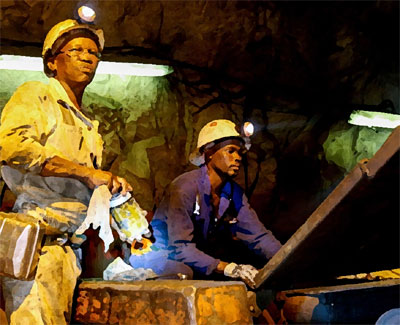
The joke was prompted by the failings of the regime. These failings were magnified when copper markets, having recovered from the incursions of aluminum, began to thrive. The Japanese “economic miracle,” American stockpiling for its war in Viet Nam, and several other factors drove copper prices to dizzying heights.
When, despite this infusion of capital, Ngongo seemed slow to modernize —where were the new schools, factories, hospitals?— people looked to the usual culprits, incompetence and corruption. Since President Batakoudou appeared to lead a rather austere personal life, the criticism was amended: the man was an incompetent manager whose cronies robbed the country blind, with or without his connivance.
Throughout the first decade of Batakoudou’s rule, Defense Minister Nkwema kept his head low. I continued putting out brush fires, to which were now added growing restiveness in the ranks of the army, itself. I also continued to bow to escalating Presidential demands for deference. Increasingly, Fons Batakoudou seemed comfortable only in the company of sycophants.
For a time, I found compensation in the happiness of starting a family. Between 1963 and 1971, at two-year intervals, Sally and I produced five children. (Had she not eschewed the services of a wet nurse, we might have produced ten!) I should point out that our first child, a girl, was born “out of wedlock.” Was that wrong of us? At all! Lugbara custom recommends a trial period before final purchase.
But, all too soon, a large cloud descended on our small world. In quick succession, between 1968 and 1970, all three of our girls succumbed to a new disease that was sweeping the continent.17 Our two boys, Julius Robert (b.1969) and Paul-Auguste (b.1971) also contracted this disease, but both managed to recover. It is a terrible thing to have to admit (especially for a Lugbara), but would that only one of them —Paul— had survived! My motives for this startling admission will soon become apparent.
An important incident from the decade will serve to characterize the gap between my early relationship with Fons Batakoudou and what it became. On the morning of Tuesday, 2 January 1968, he summoned me to his home office, which was on the second floor of the Presidential residence, looking out on the lawn where the wedding party had taken place. Since our meetings were normally held in the nearby Government Administration building, the change of location was an indication that the President had summoned me on extraordinary business.
A second indication was the timing of the summons. It was so soon after the Christmas and New Year’s break, when most business in Ngongo was still suspended, that it occurred to me the President might be intending to catch me by surprise. Since he was a notorious teetotaler, and I was still suffering the effects of the official New Year’s Eve celebration two nights before, which had taken place right here in the Presidential residence, he may have wanted additional leverage for this meeting. At the party, as I had noticed him ostentatiously sipping his usual iced mineral water, Batakoudou must have seen me downing my usual strong G&T’s. To a degree, though, the playing field for our meeting was level: he may have tilted it in his favor, but I had noticed, and was on my guard.
First came the usual preliminaries. A liveried servant appeared, carrying a silver tray. On it was a plate with six of my favourite biscuits, cocoanut macaroons, and a second plate with three of the President’s own favorite, Palmier caramel butter biscuits. Also on the tray were a small cup of pre-sweetened espresso ngongien and a tall glass of mineral water. After we had sipped, munched, and exchanged a few banalities about the weather and our families, Batakoudou got to the point.
“You are aware, mon cher Generale [my ministerial post came with this military rank], that the bastard miners’ union is once again acting up.”
I said nothing; they were always “acting up.”
“This time, however, they have learned a new tune, complaining that the French-owned concessions are reaping too great a share of the profits extracted from the exploitation of notre cuivre, as produced by our heroic travailleurs [workers].
“Quoi de neuf,” [What else is new?] I remarked, with a shrug.
“What is new is that their leaders, those bastard union agitators, have adopted a new watchword: “nationalization.” They seem, alas, to be aware of kindred movements among our neighbors, not just the so-called ‘land reform’ known as Ujamaa in Tanzania, but more to the point, the seizure of foreign copper assets in Congo, and the promise of the same, in Zambia.”18 I had never seen Fons Batakudou so agitated. “There is a fire spreading across Africa. When it becomes a conflagration, it will engulf us all, including poor Ngongo.”
I tried to remain calm. “What, then, do you propose, Excellency?”
“Surrender, Festus, I propose surrender! We must nationalize the copper industry voluntarily, before they force us to do it.”
This startling suggestion raised several simultaneous questions in my mind. After briefly wondering which to ask first, I determined to begin close to home, because that would seem most natural. “But what about the shareholders, like my father?”
I had pressed the right button. Sipping from his glass, Batakoudou sighed, and said, “Not to worry, old friend! I intend to create a six-man Board of Directors for the newly nationalized industry, with more than adequate compensation. Instead of collecting dividends, your father will earn an equivalent salary.”
I chewed on a macaroon, then asked what I thought was the obvious follow-up question. “And the workers? Will they be satisfied with the new arrangements?”
As he had, with my first question, Fons had anticipated this one. “Of course they will, mon copain [my pal]. Their satisfaction is the main point of the changeover. The miners will all receive minimal increases in wages and other forms of compensation, seasoned with large dollops of patriotic, egalitarian connerie [bullshit].
“Oh, and, of course, to anticipate a further question, I will begin the process by engaging the French owners of L’Union Miniere in negotiations over compensation —protracted negotiations. I will also employ a portion of the profits from our newly acquired assets for programmes de services sociales. These programmes will, of course, provide new opportunities for Ngongo’s public-spirited entrepreneurs.”
At that point, did this normally undemonstrative man actually wink at me, or did I just imagine it? At any rate, the brief meeting ended with some empty reassurances about the new plan’s making my own job easier. He met my parting bow by offering a warm shake of his bony hand, the first I could remember since my wedding day. What he had said about the new plan might have made sense, except for a single large doubt: would it work?
As I was about to leave the room, Batakoudou looked so anxious that I ventured a reassuring joke: “But aren't you afraid, Excellency, of being branded a Socialist?” He replied with a knowing little smile. As I walked down the hall toward the circular marble staircase, I saw several other Ministers pacing back and forth, as they awaited their turns. Among them was a personal enemy of mine, the ministre des affaires economiques, a portly, bald, and ruddy-complected little Belgian. I imagined he would tell Batakoudou exactly what he wanted to hear.
Note 17: This virulent disease was most likely an influenza A (H3N2) virus, comprising two genes from an avian influenza-A virus, including a new H3 hemaglutinin, but also containing the N2 neuraminidase from the 1957 H2N2 virus.
Note 18: Nkwema’s thumbnail account of the economic ramifications of pan-Africanism is, again, substantially accurate.
To be continued...
The Piker Press moderates all comments.
Click here for the commenting policy.