
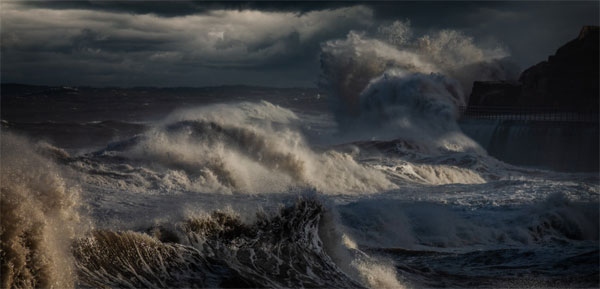
The Storm Gathers
By the time he reached the rocks, the storm was nearly upon him. The waves crashed against the shore with a force that made the ground tremble. Lightning flickered behind the clouds, illuminating the water in brief, violent flashes.
He stood at the edge of the stones, heart pounding, searching for any sign of her.
For a moment, he saw nothing.
Then — a ripple.
A shadow.
A shape rising from the water.
She stepped onto the rocks; the storm wind whipped her hair around her face. She looked different — not faded, as she had in autumn, but sharpened, as though the storm itself had carved her into something fierce and bright.
“You came,” she said.
“I had to.”
“Yes,” she murmured. “You did.”
The waves surged behind her, spraying cold salt across the stones. She didn’t flinch.
“It is time,” she said.
“For what?”
“For the choice.”
He felt the world tilt beneath him. “I don’t understand.”
“You do,” she said softly. “You have always known.”
Lightning split the sky, illuminating her face — the sorrow in it, the longing, the fear.
And then, faint but unmistakable, he heard it:
Voices in the wind.
Human voices.
Coming closer.
The priest.
And others.
She heard them, too. Her expression tightened.
“They come for you,” she said. “And for me.”
He stepped toward her. “What do I do?”
Her hand found his — cold, trembling, desperate.
“When the storm breaks,” she said, “the boundary opens. Only for a moment. If you cross with me, you will not return unchanged.”
“And if I don’t?”
Her voice broke. “Then I will be taken. And you will lose me.”
The wind howled.
The waves rose.
The voices grew louder.
Winter has come.
And with it, the reckoning.
*
The Priest Knew Her Mother
The storm broke fully as he reached the rocks.
Waves slammed against the shore with a force that made the stones tremble. Lightning split the sky in jagged white lines. The wind howled like something alive. The sea was no longer water — it was a threshold.
She stood at the edge of it, hair whipped wild, eyes bright with fear and something fiercer.
“It is open,” she said. “Only for a moment.”
He stepped toward her, heart pounding. “Then let me—”
A shout cut through the wind.
“Stop!”
He turned.
The priest was coming down the path, lantern swinging wildly, robes plastered to his legs by the rain. Two villagers followed — the younger man from autumn, and the grey‑haired woman who remembered the old ways.
The young man looked frightened.
The older woman looked grim.
The priest looked like a man walking toward a memory he had spent years trying to bury.
“Step away from her,” the priest said, voice raw.
The clerk stood his ground. “Father—”
“You don’t know what she is.”
The selkie’s voice was steady. “He knows enough.”
The priest flinched — not at her words, but at her voice.
Recognition flickered across his face.
Not her.
But of someone else.
Someone older.
Someone gone.
He whispered a name — soft, broken, carried away by the wind.
It was not her name.
It was her mother’s.
The selkie stiffened.
The clerk felt the world tilt.
“You knew her,” the selkie said quietly.
The priest’s lantern shook in his hand.
“I was young,” he said. “Foolish. I walked the shore at dusk. I heard singing. I thought—”
He stopped, jaw tightening.
“I thought it was meant for me.”
The selkie’s expression softened — not with pity, but with understanding. “It was not.”
“No,” the priest said. “It was not.”
The storm wind tore at them. The sea surged higher, glowing faintly in the lightning flash. The boundary was opening — he could feel it in his bones.
The priest’s voice cracked.
“I turned away. I chose the Church. I told myself it was righteousness.”
He swallowed hard.
“But I have wondered, every winter since, whether it was only fear.”
The clerk stared at him.
The selkie stared too.
Even the wind seemed to pause.
The priest looked at the clerk with something like grief.
“I know what it is to be called,” he said. “And I know what it is to refuse. I have lived with the silence ever since.”
The older woman stepped forward, placing a steadying hand on the clerk’s arm.
“Some choices,” she said, “echo down the bloodline.”
The selkie reached for the clerk’s hand — cold, trembling, desperate.
“When the storm breaks,” she said, “the boundary opens. Only for a moment. If you cross with me, you will not return unchanged.”
“And if I don’t?”
Her voice broke. “Then I will be taken. And you will lose me.”
The priest stepped closer — not to stop him, but as if reaching for something he had lost long ago.
“Choose,” he whispered. “But choose with your eyes open.”
The storm roared.
The sea glowed brighter.
The boundary thinned to a thread.
The selkie pulled him toward the water. “Now.”
The priest reached out — not to restrain, but in a gesture of helpless, human sorrow.
The clerk looked at the selkie.
At the priest.
At the villagers.
At the storm tearing the world open.
*
The Crossing
The storm reached its height.
The sea glowed faintly in the lightning flash, the boundary thinning to a trembling veil. The selkie held his hand with a grip that was both desperate and gentle, as though she feared he might vanish if she let go.
“You must choose,” she whispered.
The priest stood a few paces behind him, rain running down his face like tears he would never admit to. The lantern in his hand flickered wildly.
“Think,” the priest said, voice raw. “Think before you step into something you cannot return from.”
The clerk turned to him.
The priest’s eyes were not angry.
Not condemning.
Only full of a grief so old it had worn itself smooth.
“You knew her mother,” the clerk said quietly.
The priest flinched — a small, involuntary movement.
“Yes.”
“And you turned away.”
“I did.”
“Do you regret it?”
The priest closed his eyes.
The storm roared.
The sea surged.
When he opened them again, the truth was there — unguarded, unadorned.
“Every winter,” he said.
The selkie’s fingers tightened around the clerk’s hand.
The older woman — the one who remembered the old ways — stepped forward, her cloak whipping in the wind.
“Some choices,” she said, “are meant to be carried by the young.”
The clerk looked at the selkie.
At the priest.
At the storm tearing the world open.
And then he stepped into the water.
The selkie pulled him close, guiding him as the sea rose around them. The cold hit him like a shock, then softened, then warmed, as though the water itself recognized him.
Behind him, he heard the priest shout his name — not in anger, not in condemnation, but in something like heartbreak.
The boundary flared with light.
The sea swallowed them both.
And the world went silent.
*
When the storm finally broke, the priest stood alone on the rocks, lantern guttering in his hand. The villagers had retreated. The older woman lingered a moment, watching him with a mixture of pity and respect.
“You did what you could,” she said.
He didn’t answer.
“You tried to spare him your sorrow.”
Still, he said nothing.
“You loved him,” she said softly. “Not as a son, perhaps. But as someone you hoped might walk the path you chose.”
The priest’s jaw tightened.
His knuckles whitened around the lantern’s handle.
“He made his choice,” she said. “As you made yours.”
She left him then, climbing the path back toward the village.
The priest stayed.
He stood on the rocks long after the tide had smoothed away all traces of the crossing. The lantern finally went out. The wind died. The sea lay still.
He whispered the selkie mother’s name — the name he had not spoken in decades — and felt the old ache rise in him, sharp and clean.
But something else rose with it.
Not bitterness.
Not envy.
Not fear.
A strange, quiet peace.
Because the clerk had chosen what he could not.
Because the story had not ended in silence this time.
Because, in some small way, the priest felt the weight of his own regret lift — not erased but shared.
In the days that followed, the villagers noticed a change in him.
His sermons softened.
His temper eased.
He listened more.
He walked among them with a gentler step.
He did not speak of the crossing.
He did not speak of the clerk.
He did not speak of the selkie’s mother.
But he carried himself like a man who had finally laid down a burden he had held too long.
And the villagers — even those who feared the old ways — found themselves drawing closer to him, as though sensing that something in him had healed.
Winter settled over Crosshaven.
The priest lit a candle for the clerk each night.
Not in mourning.
Not in anger.
But in recognition.
Because the boy had crossed where he could not.
Because the sea had taken one and returned something to the other.
Because, for the first time in years, the priest felt less alone.
The Clerk Beyond the Boundary
He woke up to stillness.
Not silence — the Otherworld was never silent — but a stillness so complete it felt like the world was holding its breath. The storm was gone. The sea lay smooth as glass, lit from beneath by a pale, shifting glow. The air tasted like salt and something sweeter, like the memory of summer rain.
She was beside him.
Not holding him — that was not their way — but watching him with an expression he had never seen on her face before. Relief. Wonder. A fragile, trembling joy.
“You crossed,” she said.
He nodded, though the motion felt strange, as though his body was learning itself anew.
The shore behind them was not the shore he had known. The rocks were smoother, darker, shaped by tides that did not belong to the mortal world. Strange birds wheeled overhead, their cries echoing like distant bells. The horizon shimmered with colors he had no names for.
He stood — unsteady, but unafraid.
“What happens now?” He asked.
She stepped closer, her hand brushing his. “Now you learn.”
And he did.
He learned the language of tides, the names of currents, and the songs that shaped the seasons. He learned to walk the boundary paths, where the sea met the sky, and the sky met the deep places beneath. He learned the old stories — not the ones told by fishermen, but the ones whispered by the waves themselves.
He learned what it meant to belong to two worlds.
And sometimes he stood at the edge of the Otherworld and looked back toward the mortal shore. He could not see it. The boundary hid such things. But he felt it, faint like a heartbeat.
He wondered if the priest still lit a candle.
He wondered if the villagers still whispered.
He wondered if the world he had left remembered him.
He did not regret crossing.
But he carried the memory of the mortal world like a stone in his pocket — small, smooth, and precious.
Winter has passed.
Spring has approached.
And he walked forward into a life he had never imagined. With her beside him, the sea was singing beneath their feet.
*
The Priest in Spring
Spring came late that year.
The storms lingered longer than they should have. The frost clung to the fields. The fishermen muttered about strange tides. But when the thaw finally came, it came all at once — a rush of meltwater, a softening of the earth, a greening of the hedgerows.
The priest felt it like a loosening in his chest.
He had not spoken of the winter storm.
Not to the villagers.
Not to the bishop.
Not even to the older woman who had stood beside him on the rocks.
But something in him had shifted.
He walked the village paths more slowly now, stopping to speak with those he once hurried past. He listened more. He scolded less. His sermons softened, turning from warnings to comforts, to guidance.
He did not mention the clerk by name.
But he lit a candle for him each night.
Not mourning.
Not in anger.
But in recognition.
Sometimes, when the evening light slanted across the bay, he walked to the shore and stood on the rocks where the crossing had taken place. He did not expect to see anything. He did not expect to hear anything. But he stood there anyway; hands clasped behind his back, the wind tugging at his robes.
The older woman joined him once.
“You miss him,” she said.
He didn’t deny it.
“You did what you could,” she added. “And he did what he must.”
The priest nodded. “I know.”
She studied him for a moment. “You’re gentler now.”
He gave a faint, tired smile. “Regret can harden a man. Or soften him.”
“And which has it done to you?”
He looked out at the sea — calm now, deceptively ordinary.
“I think,” he said slowly, “it has made me human.”
The woman nodded, satisfied, and left him to the wind and the waves.
The priest remained.
He whispered the selkie mother’s name — the name he had not spoken in decades — and felt no pain in it now. Only memory. Only gratitude. Only the quiet ache of a life lived with choices made and carried.
Spring settled over Crosshaven.
The priest tended his flock with a steadier hand.
The villagers drew closer to him.
And though he never saw the clerk again, he felt — in some deep, unspoken way — that the boy had found what he was meant to find.
And that was enough.
*
In early spring, when the ice had finally loosened its grip on the bay, the priest walked the shore at dawn. The tide was low, the sand cold beneath his boots; the sky washed pale with the first light of morning. He carried no lantern now. He no longer needed one.
Far out on the water, the sea lay calm — too calm, as though remembering something it had taken and something it had given back.
He paused at the line where the waves reached his feet.
For a moment — only a moment — he thought he saw a figure standing on the distant rocks, half‑shrouded in mist. Tall. Still. Watching. The shape of a man who had once walked these shores with mortal feet.
The priest did not call out.
He did not lift his hand.
He only bowed his head, a gesture of blessing or farewell or both.
The mist shifted.
The figure was gone.
The sea breathed in and out.
Behind him, the village was waking — fishermen calling to one another, a dog barking, the first smoke rising from hearths. His flock. His people. The life he had chosen and the life he had learned, at last, to carry without bitterness.
He turned back toward them.
And far beyond the boundary, in a world shaped by tides and old songs, the clerk stood at the edge of the Otherworld’s shore. He felt the faintest tug — a thread of memory, thin as a hair, strong as a vow — and knew that someone on the mortal side had thought of him.
He placed his hand over his heart, not in longing, but in recognition.
Two worlds.
Two choices.
Two men standing at the edge of the same sea, each carrying the other in a way neither would ever fully understand.
The tide turned.
Spring has deepened.
And the story settled into a quiet place where endings and beginnings share the same breath.