
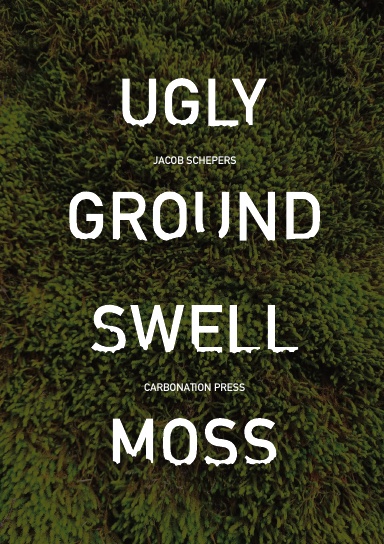
Spooning Couple: a review of Ugly Ground Swell Moss by Jacob Schepers. Carbonation Press. Spokane WA. 2026. $16.00 paper
What’s not in these poems? No doors, no orchards, no tunnels, no rivers. But it would miss the mark to think there are no people. Self and other are pervasive. I and you. Speaker and listener. And at times throughout they seem to change places. Just as the apotheosis shifts from ugly ground to swell moss. Just as the speaker is an integral part of these poems, so is the listener. This is a strange book, but poetry that is fresh and original aspires to strangeness. But who wants to sound like everybody else? Not the author. In his book words are things, questions are answers, and the speaker’s role and the listener’s are interchangeable.
Words are not representations of things; they are the things themselves. A knowledge of Carl Linnaeus’s classifications: animal, mineral, plant/ vegetable is helpful. A basic knowledge of geology is helpful, but finally not an absolute necessity for an appreciation of this poem—these poems. But what is absolutely necessary is an open mind and a willingness to be taken in …to lines, to words on a page. The book is divided into four sections: To Name, To Call, To Maim, and To Cull. The book as a whole is as much about language as it is about ground and moss. In the first taxonomy, the listener is told to forget "a that which makes sense of this.” Outside the poem the word chair represents a made a thing, the word apple represents a fruit that grows on a tree. Inside this poem—these poems, words are things, and their thingness is evident in the poet’s employment of apotheosis.
Ugly ground, swell moss finds you worth keeping near.
Ugly ground, swell moss knows of some face of you you cannot.
Ugly ground, swell moss wants you all to itself. To cover you until your
surface area is its surface area (7).
Ugly ground is, and is here. And hears. And swell moss knows "of some face of you you cannot." Simply by being what you are. On the preceding page the speaker tells the listener that this is “A brief drama of something, yes, like memory.” Who has not touched dirt, or felt moss? Here the dirt is the epithet "ugly ground” and the moss, the complementary epithet "swell moss,” not representations but the things themselves.
To consider that these poems are about language (they are language alive) is to be mindful of the adage that poetry is more about questions than answers. In the book’s second section, To Call, the speaker says:
Swell moss, you are change as much as ugly ground.
Change is that which time measures and you are still bound to time as
much as ugly ground.
Swell moss, what iteration of this might you choose if you could?
Ugly ground has grown weary, accustomed to such measures—what
with all these seismographs and all the worry that comes with
stability, the lack thereof—the threat a gentler nature might hold
at bay but hardly to say a waning off, a warning of sorts.
What sort of warning do you, swell moss, give off?
What horrors have you witnessed, that is, just by being there? (29)
That questions are answered by questions posits the speaker as a seeker, continually stating things, such as “you are change,” and wanting to know other things, with one question leading to another, a sort of probing beneath the surface of things, delving into the unknown.
The speaker is a sort of equal opportunity employer, addressing ugly ground, giving equal time to addressing swell moss in this “brief drama.” Just as these two entities, at times, seem interchangeable, so do the roles of speaker and listener. So it’s just as much a matter of who is listening as who is speaking. Perhaps, just as the listener derives a sense of personality in ugly ground and swell moss from not only what is said but how, the speaker derives a sense of the listener’s personality. The irony is that the players in this drama, the stars of the show, are nonhuman. But to go back to the speaker, the speaker as seeker, lines paused by dashes; statements and questions studded with interjections and afterthoughts give the clear impression of thinking while speaking, and sometimes, preoccupied by a thought, the speaker seems to be saying one thing while thinking of another. In section IV, To Cull, the speaker addresses ugly ground:
What have you forgotten—of course forgetting outside yourself, as if a
choice dwells there, as if swell moss knows the scale and
timeframe—best.
What scale on which you operate and on which swell moss works to
make it all the more—if nothing less than—the counterpart.
What swell moss strives for. What ugly ground forgives and begrudges.
What ugly ground knows needs to be let go of.
If only swell moss were not clinging.
If only a stronger sentiment were made available.
So, swell moss, where do we go from here? (63)
The passage begins by addressing ugly ground and ends by questioning swell moss. If only it were the other way around. Only if things were different could it be, might it begin with swell moss and end with (an address, a question to) ugly ground. Just as their roles "seen” interchange, so seem the roles of speaker and listener.
To the credit of author Jacob Schepers, his book is not what many, perhaps most readers would consider conventional. Is it a “brief drama”? Yes. Is it a book rife with wonder and mystery? Yes. Is it attentive to language, with diction that ranges from words such as permafrost to phrases such as “pop the question”? Yes. Does a reader have to have a degree in geology to appreciate this book? No. Would a reader want to read the poems in this book two or three times or more because they say substantial things in intriguing and eloquently written lines? Yes, and yes! This is a book that, once you read it, you will read again.